
$1,500.00
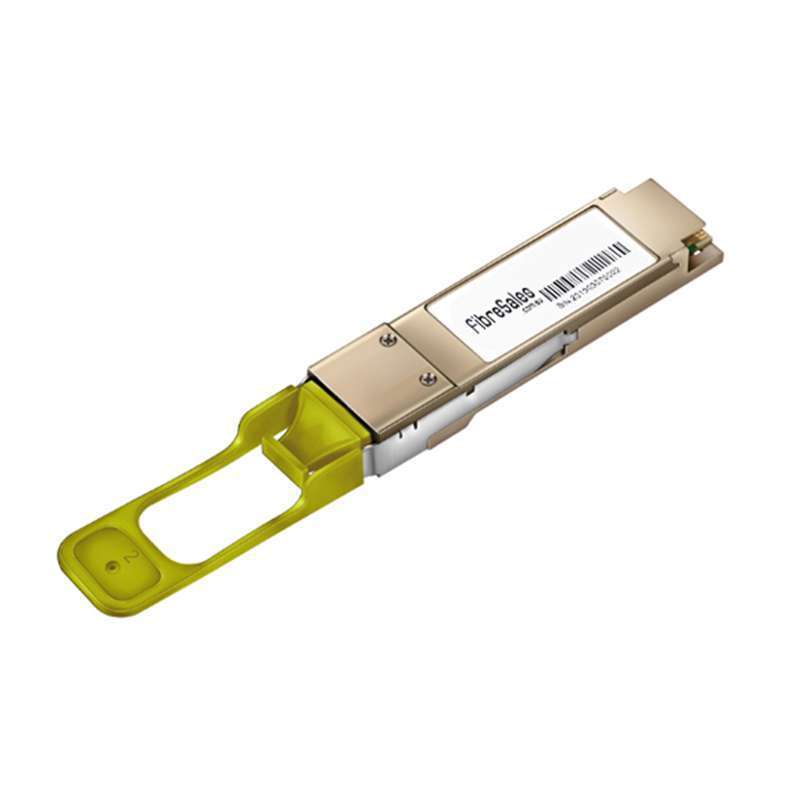
The fibreSales QSFP+ 40G-ER4 Transceiver delivers high-speed 40 Gigabit Ethernet connectivity over singlemode fibre for links up to 30 km. Designed for long-distance optical networking, the module operates across four optical wavelengths in the 1310 nm region and combines them onto a duplex singlemode fibre connection.
Unlike 40GBASE-SR4 parallel multimode optics, the ER4 transceiver uses wavelength division multiplexing to carry four optical channels over a conventional duplex LC singlemode fibre connection.
The compact QSFP+ form factor provides 40Gbps connectivity for data centres, enterprise networks, telecommunications infrastructure, campus networks and other long-distance 40GbE applications.
A 40G-ER4 QSFP+ transceiver provides long-distance 40 Gigabit Ethernet connectivity over singlemode fibre.
QSFP stands for Quad Small Form-factor Pluggable. The module carries the 40GbE signal across four optical channels, with each channel operating at approximately 10 Gbps.
However, ER4 differs significantly from an SR4 multimode transceiver.
SR4 uses separate parallel fibres for its optical lanes. In contrast, ER4 uses wavelength division multiplexing to combine four optical wavelengths onto a duplex singlemode fibre connection.
This architecture allows 40GbE to travel over significantly greater distances without requiring a parallel MTP/MPO fibre connection.
The 40GBASE-ER4 architecture divides the 40 Gigabit Ethernet signal across four optical channels.
| Optical Architecture | Specification |
|---|---|
| Number of Channels | 4 |
| Approximate Data Rate per Channel | 10 Gbps |
| Aggregate Ethernet Rate | 40 Gbps |
| Optical Region | 1310 nm |
| Fibre Type | Singlemode |
| Connector | Duplex LC |
| fibreSales Rated Distance | Up to 30 km |
Inside the transceiver, optical multiplexing combines the four transmit wavelengths onto a single fibre.
At the receiving end, the module demultiplexes the incoming optical signal back into its four individual channels.
This WDM architecture allows the transceiver to provide 40Gbps connectivity using a standard duplex singlemode fibre path.
The fibreSales 40G-ER4 supports optical links up to 30 km over singlemode fibre.
This extended reach makes the module suitable for applications that exceed the capabilities of short-reach multimode transceivers and 10 km LR4 connections.
Typical applications include connections between:
Actual transmission performance depends on the complete optical link. Fibre attenuation, connector loss, splice loss, patching and other components all contribute to the available optical loss budget.
The 40G-ER4 does not transmit the entire 40Gbps signal on one optical wavelength.
Instead, the transceiver uses four separate wavelengths in the 1310 nm region.
The module multiplexes these wavelengths internally before transmitting them across the singlemode fibre link. At the opposite end, another ER4 transceiver separates the wavelengths and recovers the individual data channels.
This internal WDM design gives network engineers 40GbE performance while retaining the familiar two-fibre connectivity used throughout many existing singlemode networks.
The QSFP+ 40G-ER4 uses a duplex LC optical interface.
One fibre carries the transmitted optical signal, while the second fibre carries the received signal.
This design differs from the MTP/MPO parallel fibre interface used by 40GBASE-SR4.
As a result, organisations with existing duplex singlemode fibre infrastructure may be able to deploy 40G-ER4 without installing the parallel fibre cabling required by SR4.
Always confirm the condition, fibre type and optical loss of the installed link before deployment.
Choosing the correct 40G transceiver depends heavily on the fibre infrastructure and transmission distance.
| Feature | 40G-ER4 | 40G-SR4 |
|---|---|---|
| Fibre Type | Singlemode | Multimode |
| Typical Application | Long distance | Short distance |
| Optical Region | 1310 nm | 850 nm |
| fibreSales ER4 Reach | Up to 30 km | — |
| SR4 OM3 Reach | — | Up to 100 m |
| SR4 OM4 Reach | — | Up to 150 m |
| Fibre Architecture | WDM | Parallel optics |
| Connector | Duplex LC | MTP/MPO |
| Ethernet Speed | 40GbE | 40GbE |
Choose SR4 for short-distance 40GbE connections over compatible multimode fibre.
Choose ER4 when the network requires substantially greater transmission distance over singlemode fibre.
Choose the 40G-ER4 when you need to carry 40 Gigabit Ethernet across a long singlemode fibre link.
The module particularly suits networks where:
Before selecting the transceiver, calculate the complete optical loss budget rather than relying on distance alone.
Maximum distance provides a useful starting point, but it does not tell the complete story.
Every connector, splice and length of fibre introduces optical loss.
Therefore, network designers should calculate the expected loss across the complete link and compare it with the optical budget supported by the transceiver.
The calculation should consider:
A well-designed optical link should remain within the supported optical budget under expected operating conditions.
The QSFP+ form factor combines high bandwidth with compact physical dimensions.
One module provides a complete 40 Gigabit Ethernet optical interface within a single QSFP+ port.
This allows compatible switches and networking platforms to deliver multiple high-bandwidth connections while maintaining efficient front-panel port density.
For data centres and core networks, this combination helps increase aggregate network capacity without requiring a large number of individual optical modules.
The 40G Singlemode QSFP+ 40G-ER4 Transceiver suits:
| Specification | Details |
|---|---|
| Product Type | Optical Transceiver |
| Ethernet Application | 40 Gigabit Ethernet |
| Transceiver Form Factor | QSFP+ |
| Optical Standard | 40GBASE-ER4 |
| Aggregate Data Rate | 40 Gbps |
| Optical Architecture | 4-channel WDM |
| Approximate Rate per Channel | 10 Gbps |
| Wavelength | 1310 nm region |
| Fibre Type | Singlemode Fibre |
| Maximum fibreSales Rated Distance | 30 km |
| Optical Interface | Duplex LC |
| Transmission | Full Duplex |
| Installation | Hot-pluggable |
| Application | Long-distance 40GbE |
Long-distance singlemode links depend on a carefully managed optical loss budget.
Dirty connectors can introduce additional insertion loss and reflection, reducing the available performance margin.
Therefore, technicians should inspect connectors before connecting the QSFP+ transceiver.
Use appropriate fibre cleaning products to remove contamination and suitable fibre inspection equipment to verify connector condition.
Follow a simple process:
Inspect → Clean if required → Re-inspect → Connect
Keeping LC connector end faces clean helps protect both the transceiver and the performance of the complete optical link.
For long-distance links, technicians should verify the installed fibre before commissioning the 40GbE connection.
An OTDR can help technicians locate and characterise events along the fibre, while suitable optical loss testing can verify the overall link loss.
Testing becomes particularly important on longer links because connectors, splices and fibre attenuation all consume part of the available optical budget.
The fibreSales 40G-ER4 QSFP+ Transceiver combines 40Gbps performance with long-distance singlemode fibre connectivity.
Its four-channel WDM architecture carries 40 Gigabit Ethernet across a duplex LC fibre connection, while the 30 km rated reach supports applications that require substantially greater distance than short-reach multimode optics.
The compact QSFP+ form factor also supports high-density network equipment, making the module suitable for data centres, enterprise backbones, campus networks and telecommunications infrastructure.
For organisations that need high-bandwidth connectivity across long singlemode fibre links, the fibreSales 40G-ER4 provides a practical 40GbE optical solution.
The fibreSales 40G Singlemode QSFP+ 40G-ER4 Transceiver delivers high-speed 40 Gigabit Ethernet connectivity over singlemode fibre for distances up to 30 km.
The transceiver uses four optical channels in the 1310 nm region and combines them through WDM technology onto a duplex LC singlemode fibre connection.
This architecture makes the module ideal for long-distance data centre, enterprise, campus, backbone and telecommunications links where short-reach multimode transceivers cannot provide sufficient distance.
For more fibre optic solutions, technical resources, and installation products, visit www.fibresales.com.au.