Introduction: Why Standard Fibre Isn’t Enough
Every contractor who has worked on a fibre project knows one universal truth: fibre is fast, but fragile. The glass strands at the heart of a fibre cable can move terabytes of data in seconds, but drop a spanner on them, expose them to rodents, or bury them under shifting soil, and that speed disappears in an instant. This is where an armoured fibre cable can come in handy.
Indoor office networks rarely push fibre to its limits, but outdoor projects, rugged industrial jobs, and direct burial installs are different. These environments demand a cable that won’t fail under pressure. That’s why armoured fibre cables are a game-changer.
In this guide, we’ll take a deep dive into what makes armoured fibre unique, the conditions that require it, the types available, and the best practices contractors should follow. By the end, you’ll know exactly when and where to specify armoured fibre cables — and how they protect against costly rework, downtime, and damage.
External Links
What Is an Armoured Fibre Cable?
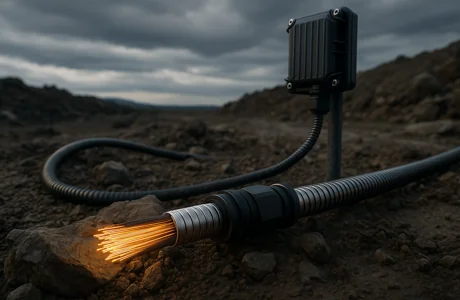
At its core, an armoured fibre cable is a standard fibre optic cable wrapped in an additional protective layer of steel or aluminium armour. This armour sits between the inner fibre buffer and the outer jacket, acting as a shield against crushing, rodent bites, and other physical threats.
A standard fibre cable typically includes:
Central strength member (for pulling strength).
Fibre cores (singlemode or multimode).
Buffer tubes and fillers (protecting the fibres inside).
Outer sheath (usually PVC, LSZH, or PE).
But with armoured fibre, you add an extra layer:
Corrugated steel tape (CST) or
Steel wire armour (SPA)
This transforms the cable from something designed for controlled environments to something ready for construction sites, mines, and outdoor trenches.
Think of it this way: a standard fibre cable is like a car tyre, while an armoured fibre cable is like a truck tyre with steel reinforcement. Same purpose, different durability.
Why Contractors Choose Armoured Fibre
Contractors don’t specify armoured fibre cables by accident. They do it because they know the cost of failure.
Standard fibre → fine for offices, data centres, and racks.
Armoured fibre → essential where anything external could damage the run.
The main drivers are:
Rodent Resistance – Rats, mice, and even termites can chew through plastic sheaths. Steel armour stops them cold.
Crush Resistance – Heavy machinery, accidental impacts, and soil compaction can destroy standard fibre. Armour distributes weight and impact.
Weatherproofing – Outdoor-rated armoured fibre often includes water-blocking gel/tape, UV protection, and temperature tolerance.
Security – Armoured fibre is harder to tamper with, useful in CCTV/security installs.
Lifecycle Value – Less maintenance, fewer site call-outs, and lower long-term costs.
For contractors, choosing armoured fibre upfront saves thousands in call-back costs.
See the fibresales Armoured Patch Cables
Armoured Fibre vs. Standard Fibre: A Side-by-Side Comparison
| Feature | Standard Fibre Cable | Armoured Fibre Cable |
|---|---|---|
| Durability | Low (fragile glass) | High (armour layer resists crushing & rodents) |
| Indoor Applications | Ideal | Possible, but overkill |
| Outdoor Applications | Risky | Designed for rugged use |
| Rodent Resistance | None | Strong |
| Cost | Cheaper upfront | More expensive upfront, cheaper long-term |
| Lifespan | Moderate | Extended |
| Direct Burial | Not suitable | Often suitable |
The Two Main Types of Armoured Fibre Cable
Not all armour is created equal. Contractors usually work with one of these two:
1. Corrugated Steel Tape Armoured (CSTA)
A flexible corrugated steel tape layer.
Offers strong protection with some flexibility for bends.
Common in direct burial installs.
Resistant to rodents and crushing.
2. Steel Pipe Armoured (SPA) (used in FibreSales cables)
A solid steel pipe layer around the fibre, providing maximum protection.
Much stronger than tape-only construction.
Rigid, highly durable, ideal for direct burial and harsh environments.
Superior crush resistance and rodent protection.
Contractor Tip: If your cable needs to snake around ducts or bend during install, CSTA is easier to work with. If you’re burying fibre in rocky terrain, SWA is the safer choice.
When Do You Need Armoured Fibre Cables?
Outdoor Fibre Installs
The number one use case. Whether running fibre between buildings, across campuses, or into underground ducts, armoured fibre stands up to environmental stress.
Example: A university installing fibre between lecture halls across a lawn will avoid costly re-digs by using armoured fibre.
Industrial & Harsh Environments
Factories, refineries, power plants, and mines put fibre under constant mechanical stress. Standard fibre in these environments often fails within months.
Example: A mining company running fibre to monitoring stations near heavy trucks and drilling rigs uses SWA armoured fibre to withstand vibration and crushing.
See the fibresales GRP Armoured Rodent Proof Cable
Rodent-Prone Areas
Rats and mice chew through plastic sheaths with ease. Armoured fibre’s steel barrier keeps them out.
Example: Security camera fibre lines in rural areas often fail within a year if standard fibre is used. Armoured fibre eliminates this risk.
Remote or Hard-to-Service Locations
When repairs are expensive or time-consuming, armoured fibre prevents problems before they happen.
Example: CCTV poles in a remote wind farm may be 100 km from the nearest technician. Using armoured fibre avoids constant service trips.
Best Practices for Installing Armoured Fibre
Even though it’s tougher, armoured fibre still requires care. Contractors should follow these guidelines:
Respect Minimum Bend Radius – Armour adds stiffness, but bending too tightly still damages fibres inside.
Pulling Techniques – Use cable socks and grips to spread tension evenly.
Sealing – Always seal ends with proper glands to prevent water ingress.
Testing – Use OTDR and VFL after installation to verify integrity.
Plan Ahead – If future expansion is likely, choose a higher core-count armoured cable now.
Cost vs. Long-Term Value
Many clients hesitate at the higher upfront price of armoured fibre. Contractors should communicate the lifecycle savings:
Direct burial rework can cost 5–10x the original install.
Downtime losses can far exceed cable cost.
Maintenance savings make armoured fibre cheaper long-term.
Position armoured fibre not as a “premium” option, but as the default choice for any rugged install.
Conclusion: Rugged Installs Demand Rugged Fibre
Armoured fibre cables are not for every project — but when outdoor environments, industrial sites, or rodent-prone areas are involved, they are the only logical choice. Contractors who specify armoured fibre protect not just the cable, but their client’s investment, uptime, and trust.
The rule of thumb is simple: Use standard fibre for offices, but go armoured for the real world.
FAQ
1. What makes armoured fibre different from standard fibre?
It has a steel armour layer that prevents damage from crushing, rodents, and harsh outdoor conditions.
2. Can armoured fibre be used indoors?
Yes, but it’s over-engineered for most indoor runs.
3. Is armoured fibre waterproof?
Yes, outdoor-grade models include water-blocking elements.
4. Do I need conduit with armoured fibre?
Not always — direct burial is common, though conduit adds extra protection.