
Bend-Insensitive Patch Cables G657.B? What are they?
When upgrading fibre optic networks, the type of patch cable you choose can make or break performance. Bend insensitive patch cables G657.B are designed with an optimised glass structure that allows them to handle sharp bends without significant signal loss.
At fibresales, we recommend G657.B bend-insensitive patch cables over traditional G.652 fibre for almost every patching environment, including FTTH, data centres, and high-density racks.
Why Does Standard G.652 Fibre Struggle With Bends?
G.652 fibre has been the global standard for decades. It performs well in long-distance networks thanks to its low attenuation.
But in tight routing situations—like patch panels or comms rooms—G.652 is vulnerable to bending loss. Even moderate bends can cause major attenuation, leading to reduced bandwidth or complete link failure.
For more details, see the ITU-T G.652 fibre specification.
What Makes G657.B Bend-Insensitive?
Unlike G.652, G657.B fibre has a modified refractive index profile. This design drastically reduces signal leakage when the fibre is bent, even at extreme angles.
Key advantages include:
Tight bend tolerance – as low as 7.5mm radius
Stable signal quality – minimal loss even in compact racks
Efficient use of space – perfect for high-density enclosures
What Are the Benefits of Bend-Insensitive Patch Cables G657.B?
Reduced Signal Loss – Maintains performance even with tight routing
Future-Proof Networks – Ideal for FTTH, 5G, and next-gen data centres
Simplified Installs – Installers can patch quickly without worrying about bend rules
Better Cable Management – Enables neater and denser racks
How Do G657.B and G.652 Compare Side by Side?
| Feature | G.652 Standard Fibre | G.657.B Bend-Insensitive Fibre |
|---|---|---|
| Bend radius tolerance | ~30mm | As low as 7.5mm |
| Signal loss on bends | High | Very low |
| Suitability for patching | Limited | Excellent |
| Long-distance performance | Excellent | Excellent |
Why Buy G657.B Patch Leads from fibresales?
At fibresales, we design and supply high-quality bend-insensitive patch cables G657.B with LC, SC, ST, MPO and other connector options. Every cable is:
Built with premium G657.B fibre
Available in singlemode and multimode
Customised in length, colour, and connector type
Tested for low insertion and return loss
By choosing fibresales, you’re investing in cables that ensure reliability today and readiness for tomorrow.
Proof in Action: G.652 vs G.657.B Bend Performance
To demonstrate the difference, a simple test was conducted:
A 1-metre patch lead made with standard G.652 fibre was looped into a 20mm bend radius.
The same was done with a 1-metre patch lead made from G.657.B fibre.
Results:
The G.652 patch lead showed more than 3dB of signal loss at 1550nm – enough to disrupt a stable link.
The G.657.B patch lead under the same bend showed less than 0.2dB of loss, well within acceptable limits for high-speed networks.
This clearly shows that G.657.B maintains signal integrity even in tight bends, while G.652 struggles under the same conditions.
Proof in Action: Extreme 7.5 mm Bend Radius
To push the fibres to their limits, both types were looped at a 7.5 mm bend radius (a very tight coil, about the size of a pencil).
G.652 fibre:
The signal loss spiked to greater than 10dB at 1550nm.
This level of attenuation would make the link unusable, dropping most network connections.
G.657.B fibre:
The signal loss remained under 0.5dB at 1550nm.
The link stayed fully operational, showing only negligible degradation.
✅ Result: G.657.B works where G.652 fails.
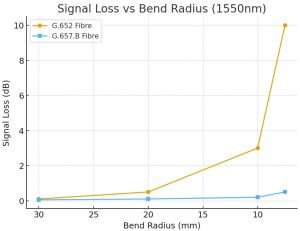
✅ Takeaway: At a 7.5 mm radius, G.652 fails completely, while G.657.B is still performing within spec. This is why bend-insensitive patch leads are essential in high-density racks, FTTH installations, and any environment where tight routing is unavoidable.
👉 Explore our range of Bend-Insensitive Patch Cables and upgrade your network with G.657.B technology today.