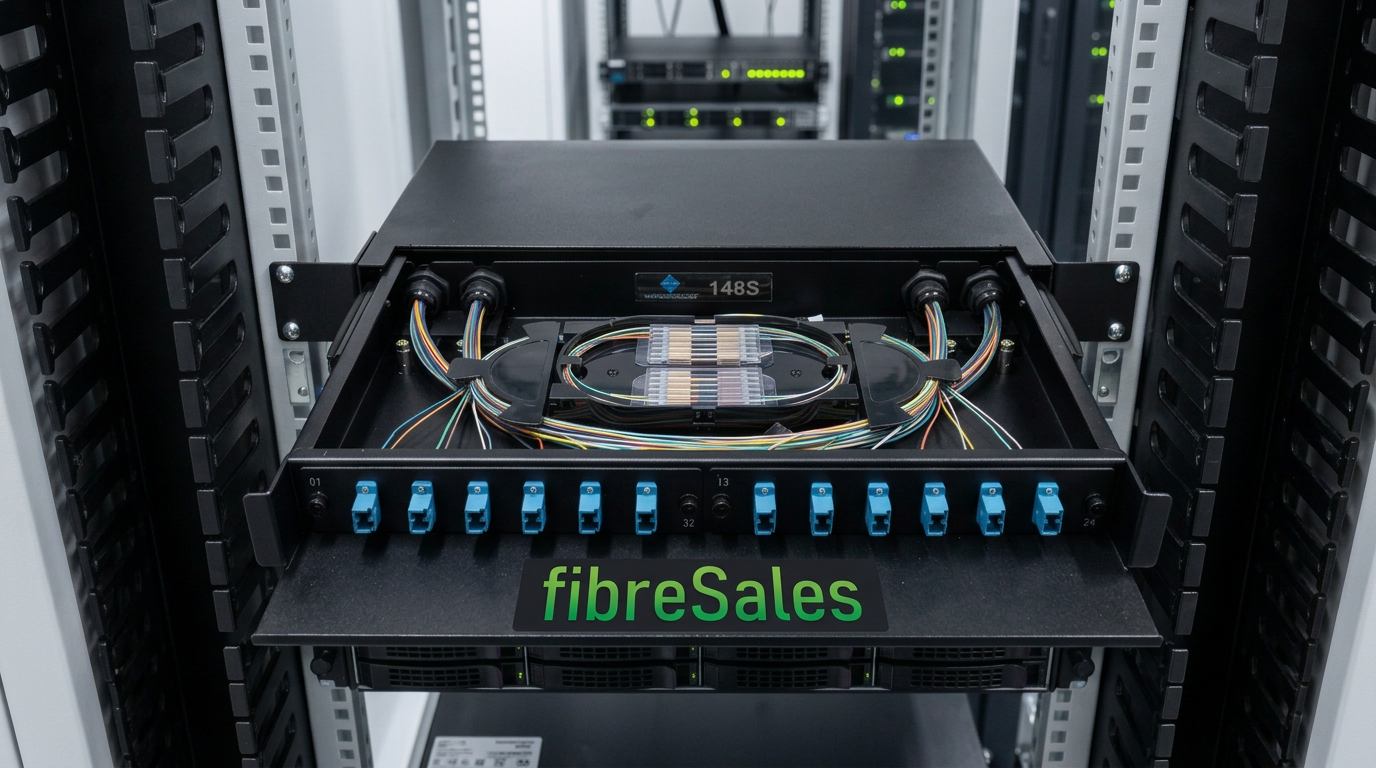
A fibre enclosure should be used when permanent fibre optic cabling needs a protected, organised and accessible location for termination, splicing or connection to network equipment. In practice, the right enclosure helps protect the permanent fibre infrastructure while giving technicians controlled access for patching, testing, maintenance and future network changes.
However, not every fibre installation requires the same solution. Therefore, before choosing an enclosure, consider what is happening to the fibre at that location and how technicians will need to access it throughout the life of the network.
When Do You Need a Fibre Enclosure?
The easiest way to decide whether you need a fibre enclosure is to look at the function of the termination point.
Consider an enclosure when:
- permanent fibre needs a defined termination point
- incoming fibres will be fusion spliced to pigtails
- completed fusion splices need protected storage
- permanent backbone fibre needs to transition to replaceable patch leads
- multiple fibres need organised identification and management
- technicians need access for testing, inspection or maintenance
- spare fibres need to be managed for future expansion
- fibre terminates inside a rack, wall-mounted location or industrial cabinet
If several of these requirements apply, the enclosure should be considered part of the fibre termination design rather than an accessory added after the cabling has been installed.
fibresales supplies Enclosures for professional fibre termination and management applications.
What Does a Fibre Enclosure Actually Do?
A fibre enclosure creates a controlled location between the permanent fibre infrastructure and the connections technicians need to access.
Depending on the design, an enclosure may accommodate incoming cable, fibre management, pigtails, fusion splices, splice protection, adaptors and outgoing patch leads.
For example:
Permanent fibre cable → fusion splice → pigtail → adaptor → patch lead → network equipment
However, this article does not need to reproduce the different patch-panel configurations, connector formats and panel types already covered by Fibre Patch Panels Explained: Types, Benefits, and Installation Tips. Instead, that guide provides the next level of detail once you have established that your installation needs an organised fibre termination point.
Use a Fibre Enclosure When Terminating Permanent Fibre
Permanent backbone and distribution fibre should have a clearly planned termination strategy.
Although some network designs allow fibre to connect directly to equipment, a dedicated termination point can separate the permanent infrastructure from connections that are likely to change during the network’s life.
For example, switches and transceivers may be replaced. Patch leads may also be disconnected for testing or network changes. Meanwhile, the permanent backbone can remain protected and largely undisturbed.
Therefore, an enclosure can be particularly useful in:
- communications rooms
- server rooms
- data centres
- commercial buildings
- industrial facilities
- campus networks
- security networks
- telecommunications installations
This separation improves serviceability because technicians can work at an accessible interface rather than repeatedly handling the permanent cable.
Use a Fibre Enclosure When Fusion Splicing to Pigtails
A common fibre termination method is to fusion splice the fibres from an incoming cable to connectorised pigtails.
A pigtail has a connector at one end and an unterminated fibre at the other. The unterminated end is spliced to the permanent cable, while the connectorised end provides the interface required for patching.
Because this creates both a splice and a connectorised termination, suitable protection and fibre management are required.
For the complete termination method, see Fibre Optic Pigtails. You can also select compatible Pigtails for fibre termination projects.
Where field splicing is required, fibresales also supplies Fusion Splicers.
Use an Enclosure to Protect Completed Fibre Splices
Creating a low-loss fusion splice does not complete the physical installation.
After splicing, the joint requires mechanical protection and suitable storage. The fibres around the splice also need to be routed so that they remain protected.
The Fiber Optic Association’s current installation standard states that splices should be placed in a protective closure appropriate to the environment. It also specifies securing cables at the closure entry and organising individual fibres within splice trays to avoid damage. The Fiber Optic Association
Therefore, the enclosure, splice-management system and cable entry arrangement should be considered together.
For a more detailed explanation of the actual splicing process, see Fibre Optic Splicing Explained rather than repeating that technical explanation here.
Use a Fibre Enclosure to Protect the Permanent Network
Equipment-side connections change more frequently than permanent backbone cabling.
Consequently, one important function of a fibre enclosure is creating a controlled interface between those two parts of the network.
Instead of repeatedly connecting and disconnecting the permanent cable, technicians can make equipment-side changes using Fibre Patch Leads.
That arrangement can simplify:
- switch replacement
- transceiver changes
- troubleshooting
- optical testing
- moves and additions
- network reconfiguration
- equipment upgrades
As a result, the permanent fibre can remain protected while the patching interface remains accessible.
Use an Enclosure When Fibre Needs Physical Protection
Optical fibre requires appropriate mechanical management, particularly where the protective elements of the main cable have been removed for termination.
At this point, individual fibres, pigtails, connectors and splices may be more vulnerable to accidental handling.
A suitable enclosure helps protect them from:
- accidental pulling
- snagging
- crushing
- connector damage
- inappropriate bending
- disturbance during equipment changes
However, an enclosure does not automatically solve these problems.
The installer still needs enough internal space to route the fibre correctly, secure the incoming cable appropriately and maintain the applicable bend requirements.
Therefore, internal usable space matters just as much as front-panel port count.
Use a Fibre Enclosure When You Need an Accessible Test Point
Fibre networks need to remain serviceable after installation.
A technician may eventually need to inspect a connector, clean an interface, measure optical performance or investigate a fault. Therefore, access should be considered when the enclosure is selected rather than after the network develops a problem.
For connector inspection, fibresales supplies Microscopes. Where fault location or fibre-link characterisation is required, OTDR equipment provides another diagnostic option.
Before reconnecting inspected interfaces, appropriate Fibre Cleaning Products can form part of the fibre maintenance process.
Therefore, an enclosure that is easy to access can make future inspection, cleaning and testing considerably more practical.
Use a Fibre Enclosure When the Network May Expand
Do not select an enclosure solely around the number of fibres active today.
For example, a backbone cable may contain 12 fibres even though only six are initially required. The remaining fibres may have been installed specifically to provide future capacity.
Therefore, consider:
Installed fibres → active fibres → spare fibres → expected future services
If future growth is reasonably foreseeable, suitable spare termination and management capacity can reduce the amount of rework required later.
However, bigger is not automatically better. The objective is to provide appropriate capacity without unnecessarily consuming rack or cabinet space.
How to Choose the Right Fibre Enclosure
Once you have established that an enclosure is appropriate, selection should begin with the installation requirements rather than simply choosing a port count.
Fibre Count
Determine the total number of installed fibres, not only the number currently being activated.
Then consider whether spare fibres need to be stored, terminated or made available for future services.
Termination Method
Ask how the fibres will be terminated.
If the design uses fusion-spliced pigtails, the enclosure needs appropriate splice management as well as connector capacity.
If the installation uses another termination method, its internal requirements may be different.
Splice Capacity
Port capacity and splice capacity are not necessarily the same thing.
Therefore, if 24 fibres require termination, confirm that the selected enclosure configuration can manage the required number of protected splices as well as the front-facing connections.
Mounting Location
Where will the termination physically sit?
A standard communications rack, wall-mounted telecommunications area and industrial control cabinet have different space and access requirements.
Cable Entry and Retention
The incoming cable needs appropriate entry and mechanical retention.
The cable should not transfer pulling or movement forces directly to individual fibres, splices or connectors.
Internal Fibre Management
Check whether the enclosure provides sufficient usable space for fibre routing, pigtails, splice trays where required and service loops.
Maintenance Access
Consider how a technician will reach the fibres later.
A compact enclosure may save space initially. However, if routine access becomes difficult, that space saving may create additional maintenance work.
Future Capacity
Finally, determine whether the network is likely to expand.
Appropriate spare capacity can be valuable, particularly where spare fibres are already present in the installed cable.
Fibre Enclosure Selection Guide
| Installation requirement | Selection consideration |
|---|---|
| Permanent backbone termination | Protected and accessible termination point |
| Fusion-spliced pigtails | Adequate splice and pigtail management |
| Communications rack | Suitable rack-mount format and RU capacity |
| Wall-based termination | Appropriate wall-mounted solution |
| Industrial cabinet | Compact mounting arrangement, potentially DIN rail |
| Frequent maintenance | Good technician access |
| High fibre count | Sufficient termination and management capacity |
| Spare installed fibres | Allow appropriate future capacity |
| Testing and troubleshooting | Accessible connector interface |
| Limited physical space | Balance compact size with safe fibre routing |
For detailed information about rack-mount, wall-mount and other patch-panel configurations, use Fibre Patch Panels Explained: Types, Benefits, and Installation Tips as the dedicated owner article for that topic.
Where Are Fibre Enclosures Used?
The underlying decision remains the same across different environments: does the permanent fibre require protected termination, management and future access?
Communications Rooms and Server Rooms
An enclosure can create the transition between building backbone fibre and network equipment while keeping the permanent cable protected.
Data Centres
Higher fibre counts make identification, controlled routing, density and maintenance access particularly important.
Commercial Buildings
Fibre backbones connecting floors or communications areas benefit from clearly defined termination points that technicians can identify and maintain.
Industrial Networks
Industrial Ethernet networks may terminate fibre inside control cabinets or other equipment locations where available space and mounting format become important selection factors.
Campus Networks
Fibre connecting separate buildings needs an organised termination strategy at each end of the link.
Security and CCTV Networks
Where fibre provides long-distance connectivity between switches or remote network locations, a suitable enclosure can protect and organise the permanent fibre termination.
Engineering Decision: Do You Need a Fibre Enclosure?
Use this decision sequence before selecting a product:
1. Is this permanent fibre?
If yes, determine how the permanent cable will terminate and how it will be protected.
2. Will the fibres be fusion spliced?
If yes, provide appropriate protected splice management.
3. Do technicians need an accessible connector interface?
If yes, plan the termination and patching arrangement.
4. Will equipment connections change during the network’s life?
If yes, separating permanent cabling from equipment-side patching can improve serviceability.
5. Are spare fibres or future connections expected?
If yes, include appropriate future capacity.
6. Where will the termination be installed?
Match the enclosure format to the rack, wall, cabinet or other installation environment.
Engineering decision: Select the enclosure around the complete termination requirement — fibre count, termination method, splice management, mounting location, access and future capacity — rather than port count alone.
Fibre Enclosure vs Direct Connection
Can fibre connect directly to equipment without an enclosure?
In some network designs, yes.
However, the more useful question is what happens during the life of the installation.
If the equipment is replaced, the connection requires testing or the network needs to be rearranged, will technicians have to disturb the permanent fibre?
Where ongoing changes are expected, a defined termination and patching point can provide a more serviceable arrangement.
Therefore, direct connection versus enclosure termination is a network-design decision, not simply a question of whether the connector physically fits the equipment.
Fibre Enclosure vs Fibre Patch Panel
The terms overlap because many fibre products perform both functions.
Broadly, an enclosure provides physical protection and internal fibre management, while a patch panel presents organised connections for patching.
However, many rack-mounted products combine those functions.
Therefore, rather than choosing by terminology alone, ask whether the product provides the functions your installation requires:
protection + termination + splice management where required + patching + access + appropriate capacity
For the detailed explanation of patch-panel types and configurations, refer to Fibre Patch Panels Explained: Types, Benefits, and Installation Tips.
Standards and Best Practices
Enclosure selection forms only one part of a compliant and reliable fibre installation.
For premises optical fibre, ANSI/TIA-568.3-E Optical Fiber Cabling and Component Standard is the current TIA revision and covers optical fibre cabling and components. TIA states that the 2022 E revision updated the previous 568.3-D standard. TIA Online
Meanwhile, ISO/IEC 11801-1 provides the general requirements for generic cabling for customer premises and remains part of the current ISO catalogue, including its 2025 amendment. ISO
For Australian installations, regulatory requirements also need consideration. ACMA states that applicable customer cabling work is regulated under the Telecommunications (Cabling Provider) Rules 2025 and identifies AS/CA S009:2020 as the installation Wiring Rules. ACMA also identifies AS/CA S008:2020 and its 2025 technical standard in relation to customer cabling products.
In addition, the BICSI Telecommunications Distribution Methods Manual (TDMM), 15th Edition provides current ICT infrastructure design guidance, including backbone distribution, telecommunications spaces, connecting hardware, field testing and data centres. BICSI Shop
Therefore, enclosure selection should be considered alongside the applicable project specification, manufacturer requirements, cabling standards and regulatory requirements.
Real-World Example: Commercial Building Backbone
Consider a commercial building with a 12-fibre backbone entering a communications room.
Initially, only six fibres are required.
Rather than taking the permanent backbone directly to network equipment, the installer can terminate it within suitable Enclosures.
If the design uses fusion-spliced Pigtails, the protected splices can be organised within the enclosure. The connectorised pigtails then provide an interface for Fibre Patch Leads connecting the backbone to network equipment.
The path becomes:
12-fibre backbone → enclosure → protected splices → pigtails → adaptors → fibre patch leads → network equipment
As a result, the backbone remains protected, equipment-side connections can change independently, and the remaining fibres can be managed for future use.
This is why enclosure selection should form part of the fibre termination design rather than being treated as a last-minute accessory.
Common Fibre Enclosure Mistakes
Choosing by Port Count Alone
Front-panel capacity tells only part of the story.
Internal fibre routing, splice management, cable entry and technician access also influence whether an enclosure is suitable.
Forgetting Splice Capacity
If the installation uses fusion-spliced pigtails, confirm how the protected splices will be accommodated.
Choosing an Enclosure That Is Too Small
A compact enclosure may appear efficient. However, overcrowding can make fibre routing and maintenance more difficult.
Ignoring Spare Fibres
If the backbone already contains unused fibres, consider how those fibres will be managed when future services are activated.
Poor Cable Retention
Secure the incoming cable appropriately so that movement and pulling forces are not transferred to individual fibres.
Ignoring Fibre Routing
Do not force fibres into tight routing simply to fit them into an undersized space.
Forgetting Future Access
Installation is only the beginning of the network’s service life. Technicians may later need to inspect, clean, test or modify the connections.
Frequently Asked Questions
When should I use a fibre enclosure?
Use a fibre enclosure when permanent fibre requires protected termination, splice management, organised patching or accessible connections for future testing and maintenance.
Does fusion-spliced fibre need an enclosure?
Permanent splices require suitable protection and management. The FOA installation standard calls for splices to be placed in protective closures appropriate to their environment and for fibres to be organised to avoid damage. The Fiber Optic Association
Do I need an enclosure when using fibre pigtails?
Where pigtails are fusion spliced to permanent fibre, an enclosure commonly provides the required location for protecting and organising the splices, fibres and connectorised termination.
Can fibre connect directly to a switch?
Yes, in some network designs. However, a dedicated termination point can reduce the need to disturb permanent cabling when equipment changes or testing is required.
What goes inside a fibre enclosure?
Depending on the design, an enclosure may accommodate incoming cable, fibre management, pigtails, protected fusion splices, splice trays, adaptors and associated termination components.
What size fibre enclosure do I need?
Base the decision on total fibre count, termination method, splice capacity, cable entry, internal management space, installation location, technician access and future requirements.
Should I allow spare capacity?
Where expansion is reasonably expected, appropriate spare capacity can make later additions easier without unnecessarily replacing or reworking the original termination.
Can the same enclosure support singlemode and multimode fibre?
The enclosure housing may suit either, depending on its design. However, the installed pigtails, adaptors, patch leads and other optical components must match the fibre system.
Do fibre enclosures need to be rack mounted?
No. The appropriate mounting arrangement depends on the environment. Fibre termination may occur in racks, wall-mounted locations, industrial cabinets or other purpose-designed infrastructure.
What is the difference between an enclosure and a patch panel?
An enclosure primarily provides protection and fibre management, while a patch panel presents organised connections for patching. Many products combine both functions.
Why does maintenance access matter?
Technicians may need to inspect, clean, test or change connections later. Therefore, good access reduces unnecessary disturbance of other fibres during maintenance.
Should I choose the smallest enclosure that fits?
Not necessarily. The enclosure needs enough usable internal space for safe fibre routing, termination, splice management where applicable and reasonable future access.
Why fibresales?
fibresales supplies the components required to build the fibre termination as a complete system rather than treating the enclosure in isolation.
Depending on the installation, that system can include Enclosures, Pigtails, Fibre Patch Leads, Fusion Splicers, Fibre Cleaning Products, Microscopes and OTDR equipment.
That allows the enclosure to be selected around the actual termination, installation and maintenance requirements of the network.
Conclusion
A fibre enclosure should be used when permanent fibre needs a protected and organised termination point, when fusion splices require suitable management, or when technicians need an accessible interface for patching, testing and future maintenance.
However, choosing the right enclosure requires more than counting ports.
Consider the fibre count, termination method, splice requirements, cable entry, internal routing, installation environment, maintenance access and future capacity. Then choose the enclosure that supports the complete termination design.
For suitable rack, wall and other fibre termination solutions, browse the fibresales Enclosures range.
Shop fibresales
Choose Enclosures together with compatible Pigtails and Fibre Patch Leads to build a fibre termination solution suited to your installation.
For more fibre optic solutions, technical resources, and installation products, visit www.fibresales.com.au.
Continue Learning
1/ Fibre Patch Panels Explained: Types, Benefits, and Installation Tips – Understand patch-panel types, configurations, benefits and installation considerations once you have established the need for a structured fibre termination point.
2/ Fibre Optic Splicing Explained – Learn how fibre splicing works and how fusion splices form part of a permanent fibre termination.
3/ Fibre Optic Pigtails – Understand how connectorised pigtails are fusion spliced to permanent fibre to create an accessible termination interface.
References
FOA Installation Standard 2025 – The Fiber Optic Association’s current installation standard provides practical guidance for fibre installation, including splice protection, closure selection, cable retention and fibre organisation. The Fiber Optic Association
ANSI/TIA-568.3-E Optical Fiber Cabling Component Standard – TIA’s current optical-fibre cabling component standard provides industry requirements and context for premises optical fibre cabling and components. TIA Online
ISO/IEC 11801-1 – Generic Cabling for Customer Premises – ISO/IEC 11801-1 provides the general requirements for generic customer-premises cabling and forms an important international structured-cabling reference. The standard remains current in ISO’s catalogue and received a 2025 amendment. ISO
BICSI Telecommunications Distribution Methods Manual, 15th Edition – BICSI’s current TDMM provides ICT infrastructure design guidance covering telecommunications spaces, backbone systems, connecting hardware, field testing and data-centre infrastructure. BICSI Shop
ACMA Australian Cabling Standards – ACMA provides the Australian regulatory context and identifies AS/CA S009:2020, AS/CA S008:2020 and related telecommunications customer-cabling requirements.