Fibre Optic Attenuators: A Vital Component in Network Management
Categories of Fibre Optic Attenuators
Fibre optic attenuators fall into two primary categories:
Fixed Optical Attenuators (FOA)
Variable Optical Attenuators (VOA)
Further classification occurs based on cable type:
Single-mode Attenuators
Multimode Attenuators
This article focuses on Fixed Optical Attenuators (FOA) and their applications.
What is a Fixed Fibre Optic Attenuator?
A fibre optic attenuator is a passive device designed to reduce the power level of an optical signal. It prevents signal overload that could damage receivers or cause data transmission errors. Unlike active devices, which require power to function, passive devices like attenuators, patch leads, connectors, and adaptors work without external energy sources.
Network engineers use attenuators when an optical signal is too strong. If a receiver cannot handle the incoming power, attenuation becomes necessary to maintain network efficiency.
Multimode systems rarely require attenuators because LEDs and VCSELs (Vertical-Cavity Surface-Emitting Lasers) have limited power output.
Single-mode systems, on the other hand, often use high-power lasers, making attenuation necessary, particularly in short-distance transmissions.
How Do Optical Attenuators Work?
Attenuators function by absorbing, reflecting, diffusing, scattering, diffracting, or dispersing light to reduce signal strength. You can compare their operation to sunglasses filtering excess sunlight, protecting your eyes from harmful UV rays. Fibre optic attenuators similarly control light intensity to prevent network disruptions.
Design and Construction of Fixed Optical Attenuators
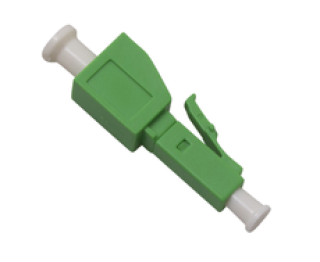
The most common fixed attenuators come in a male-to-female (plug-in) format. These adapter-style attenuators attach to one end of a connectorized fibre optic cable, allowing the cable to plug into a receiving device or patch panel.
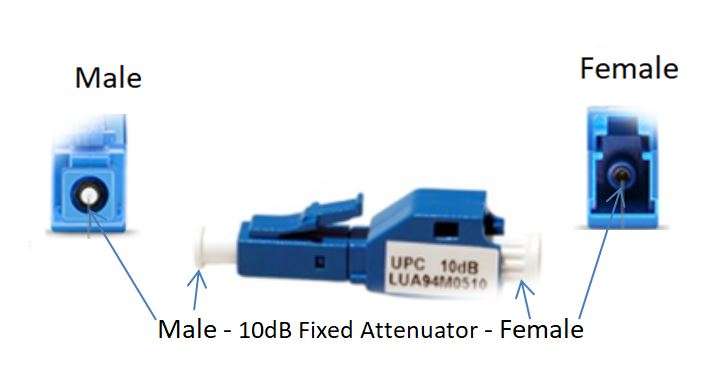
Attenuators are available for 2.5mm ferrule connectors (FC, ST, SC) and 1.25mm ferrule connectors (LC).
Engineers introduce attenuation by creating a physical gap, deliberate misalignment, fusion splicing, non-aligned filters, or applying stress to the fibre.
Fixed attenuators have a predetermined attenuation value, typically ranging from 1dB to 20dB, with common values being 1, 2, 3, 5, 10, 15, and 20dB.
These devices absorb light evenly across a defined wavelength range, ensuring a stable signal reduction without distorting data transmission.
Applications of Fibre Optic Attenuators
Network engineers deploy attenuators in various scenarios, including:
Preventing receiver overload: When optical power exceeds the receiver’s tolerance, attenuation stabilizes the signal.
Balancing channel power in Wavelength Division Multiplexing (WDM) systems: Uneven power levels can degrade signal integrity.
Testing Bit Error Rate (BER): Engineers adjust power levels incrementally to determine performance thresholds and safety margins.
Stress-testing networks: Attenuators simulate signal degradation to identify weak links and ensure reliable performance under challenging conditions.
Permanent and temporary deployments: Some attenuators integrate into network infrastructure permanently, while others assist in temporary diagnostic testing.
Calculating the Required Attenuation Level
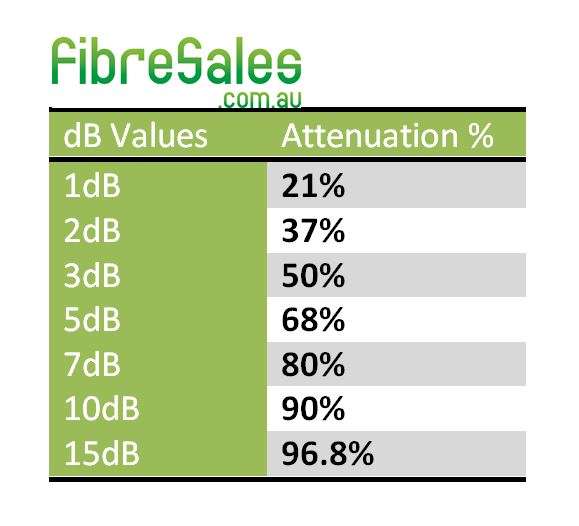
Network engineers calculate attenuation requirements using loss budgeting to verify whether the system operates efficiently. They consider two key factors:
Power budget – The maximum signal loss a data link (transmitter to receiver) can tolerate while maintaining reliable communication.
Loss budget – The estimated total signal loss based on all components in the network (cables, splices, connectors, and other elements).
Example Calculation for Attenuation
Given the following conditions:
Transmitter power (TP): 3dBm
Receiver maximum optical input power (MP): -6dBm
Total system losses (TL): 2dB
To calculate the minimum required attenuation (AR): AR = MP + TL – TP
= -6dBm + 2dB – 3dBm
= -5dB
In this case, a 5dB attenuator is necessary. However, engineers may use a higher value if needed, provided it does not over-attenuate the signal.
Conclusion
Fibre optic attenuators play a crucial role in maintaining signal integrity in optical networks. Whether used temporarily for diagnostics and testing or permanently to balance signal strength, attenuators ensure seamless communication in modern fibre optic systems. With a variety of attenuation values available, these tools remain an essential component in every network engineer’s toolkit.