
Fibre optic loopback cables, also known as loopback modules or adapters, are simplex cables that loop back on themselves. They come either as a traditional loopback cable, where the fibre is visible and clipped together, or as a loopback module, where the cable is enclosed in a protective case.

The loopback module is more compact, offering better protection and easier handling.

Purpose of Loopback Cables
Loopback cables allow technicians to send data back to the source without modification. They are used to test transmission ability and receiver sensitivity, ensuring the ports function correctly. These cables are essential for troubleshooting fibre optic networks and are widely used in network restorations.
Types of loopback cables.
Each loopback cable includes two fibre optic connectors. The type of loopback module needed depends on the connector and fibre type. Some common options include:
- LCA Singlemode loopback modules
- LC Multimode or Singlemode loopback modules
- SCA Singlemode loopback modules
- SC Multimode or Singlemode loopback modules

These cables are categorized by connector type and fibre mode, much like patch cables. Options include OM1 (62.5/125µm), OM3, OM4, OM5 (50/125µm) for multimode, and 9/125µm for singlemode
Colour Coding
Like fibre optic patch cables, loopback cables follow a colour-coding system:
- Beige – OM1 Multimode LC and SC loopbacks
- Aqua – OM3 Multimode LC and SC loopbacks
- Erika Violet – OM4 Multimode LC and SC loopbacks
- Green – SCA and LCA Singlemode loopbacks
- Blue – SC and LC Singlemode loopbacks
Connector Polish Types
For singlemode loopback modules, there are two polish types:
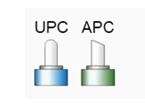
- APC (Angled Physical Contact)
- UPC (Ultra Physical Contact)
How to Use a Fibre Optic Loopback Cable
Testing a transceiver: Connect one end to the transmit port (Tx) and the other to the receive port (Rx) on the same device.
Patch Panel Testing: Plug the loopback cable into the adapter ports being tested.
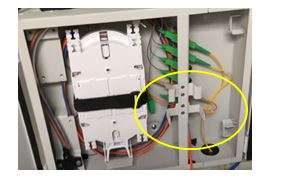
OTDR Testing: Use a loopback at one end of the cable run to test both directions with an OTDR at the other end. This method eliminates the need for two OTDRs and reduces testing time.

Specifications
- Material: Low smoke halogen, durable and fade-resistant
- Ferrule: High-precision ceramic for low insertion loss and back reflection
- Temperature Range: -40°C to +80°C (≤ 0.2 dB variation)
- Exchangeability: ≤ 0.2 dB (500 cycles)
- Fibre Modes: Singlemode (9/125µm), Multimode (50/125µm, 62.5/125µm)
- Connector Types: SC, SCA, LC, LCA, and more
- Insertion Loss: ≤ 0.2 dB
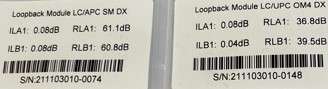
Each loopback cable comes with test results and a serial number.
Available Wavelengths
- Multimode: 850nm, 1300nm
- Singlemode: 1310nm, 1550nm
Conclusion
Fibre optic loopback cables are essential for testing, network diagnostics, and equipment validation. Available in both singlemode (9/125µm) and multimode (50/125µm, 62.5/125µm), these tools are vital for ensuring network performance. Known as loopback adapters, cables, or modules, they are a must-have for any technician’s toolkit.