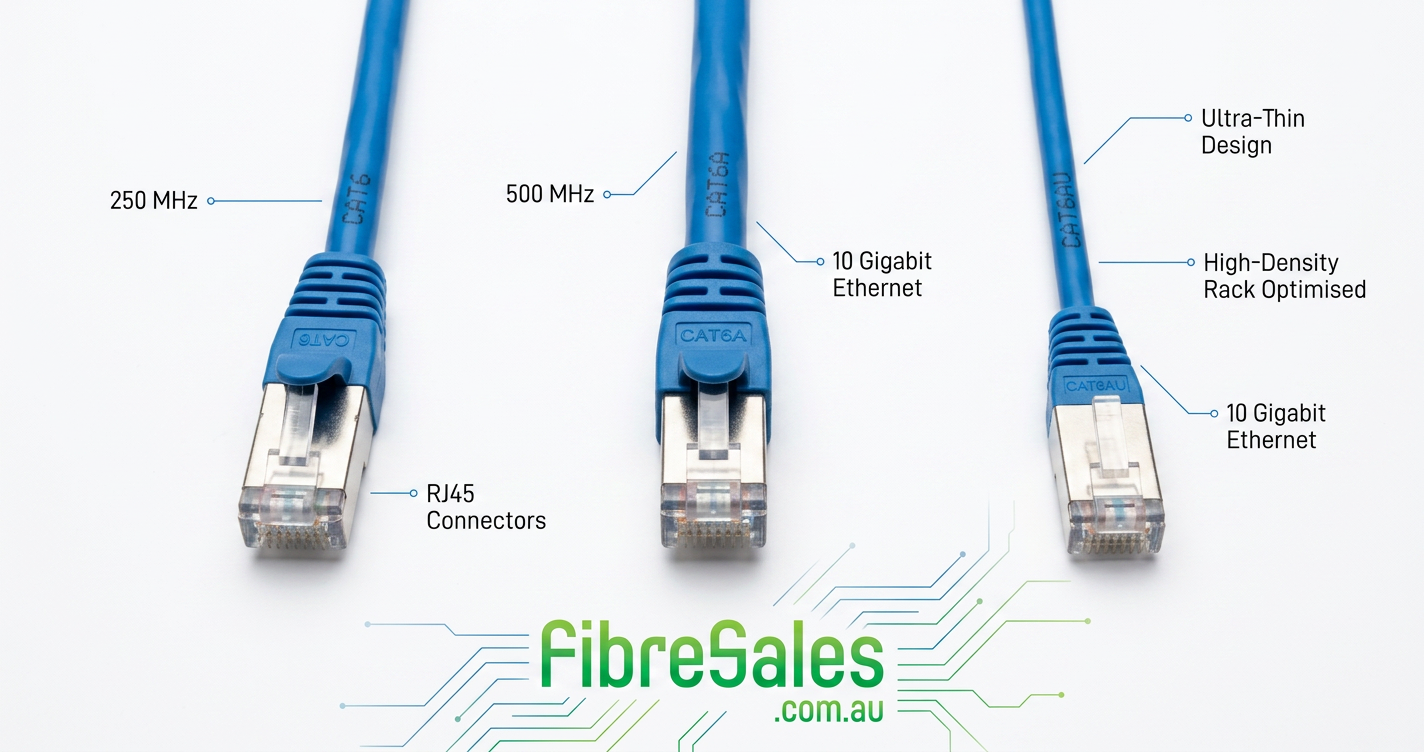
CAT6 vs CAT6A vs CAT6AU | Which Ethernet Patch Cable?

CAT6 vs CAT6A vs CAT6AU Ethernet patch cable comparison

CAT6 vs CAT6A vs CAT6AU | Which Ethernet Patch Cable Should You Choose?

CAT6 vs CAT6A vs CAT6AU is one of the most common comparisons when choosing an Ethernet patch cable for a home, business or data centre. Understanding the differences between these cable categories will help you select the right solution for your network.

Although these three cable types share many similarities, they are designed for different environments. Standard CAT6 remains an excellent choice for everyday Gigabit Ethernet networks, while CAT6A delivers higher bandwidth and reliable 10 Gigabit performance over longer distances. CAT6AU takes those same CAT6A performance characteristics and packages them into a slimmer, more flexible patch lead that is ideal for modern server racks and crowded network cabinets.

If you’re new to structured cabling, it helps to first understand how Copper Networking forms the backbone of most Ethernet networks. You may also find our guide to Copper Patch Leads Explained useful for understanding how patch leads connect switches, routers, patch panels and network devices.

In this guide, we’ll compare CAT6, CAT6A and CAT6AU side by side, explain where each cable performs best, and help you decide which option offers the right balance of performance, flexibility and long-term value for your network.


What You’ll Learn

By the end of this guide, you’ll understand:

  • The differences between CAT6, CAT6A and CAT6AU patch cables.
  • How speed, bandwidth and transmission distance compare.
  • Why CAT6AU has become increasingly popular in Australian data centres and network cabinets.
  • Which cable is best suited to home networks, business environments and high-density installations.
  • How to choose the right Ethernet patch cable for your current requirements while planning for future network upgrades.

CAT6 vs CAT6A vs CAT6AU at a Glance

FeatureCAT6CAT6ACAT6AU
Maximum Ethernet Speed10Gb up to 55 m*10Gb up to 100 m10Gb patching applications
Bandwidth250 MHz500 MHz500 MHz
Cable DiameterStandardLargerUltra-thin
FlexibilityExcellentModerateExcellent
Rack AirflowGoodFairExcellent
Best ForHomes and officesEnterprise networksHigh-density racks and cabinets
Future ReadyGoodExcellentExcellent

*Actual 10 Gigabit performance depends on installation quality, interference and channel length.


Why Understanding the Differences Matters

It’s easy to assume that newer cable categories are always the better choice, but that’s not necessarily true. The best Ethernet patch cable depends on how your network is being used, the available installation space and whether you’re planning for future expansion.

For example, a standard office network running Gigabit Ethernet may never require the additional bandwidth offered by CAT6A. On the other hand, organisations deploying high-speed switching, virtualisation, network storage or modern Wi-Fi access points often benefit from the additional performance headroom that CAT6A provides.

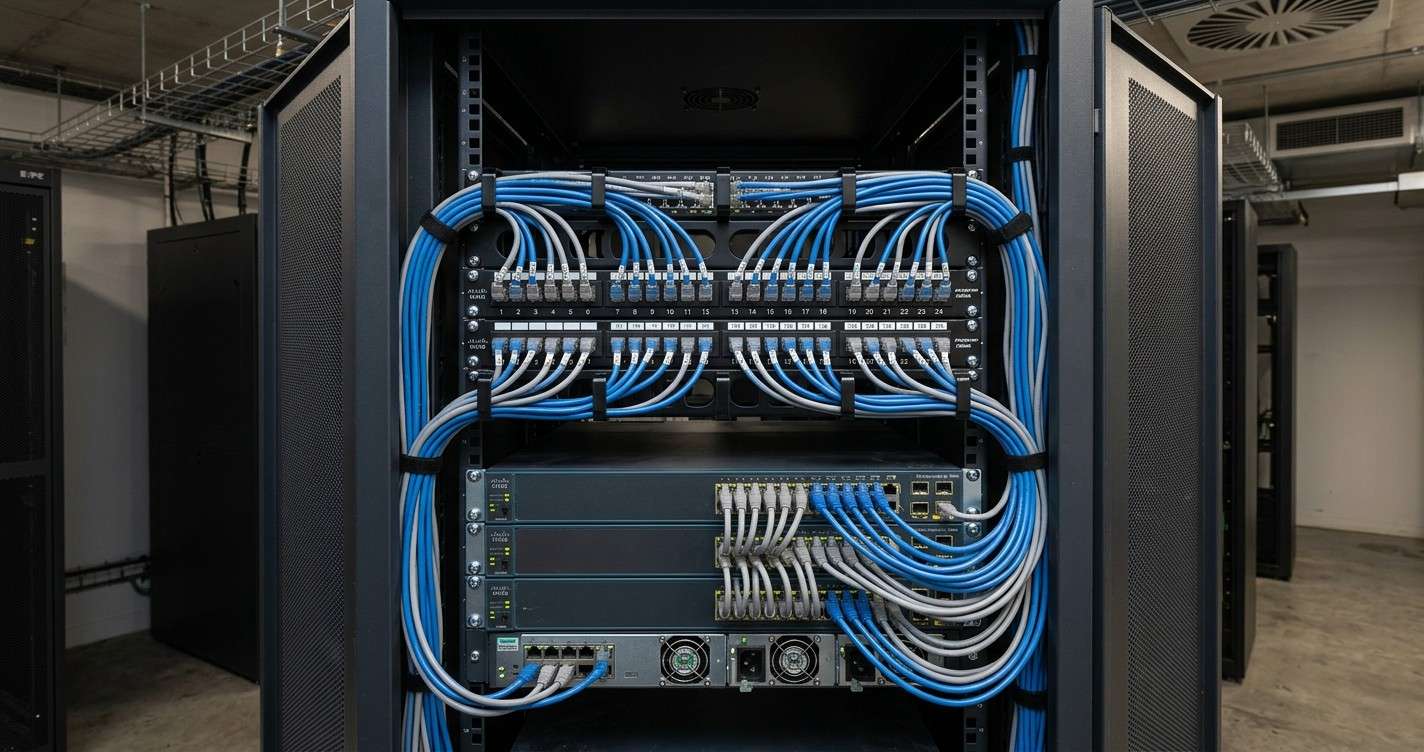
Physical cable size is another important consideration. Traditional CAT6A patch leads are noticeably thicker than CAT6, which can make cable management more challenging in crowded racks. If space, airflow and cable organisation are priorities, our guide to Slimline vs Standard Patch Leads explains why slimmer cables are increasingly being used in modern network cabinets.

Likewise, conductor size can influence flexibility and overall cable construction. If you’d like to learn more about why many premium Ethernet patch leads use 24AWG conductors, see our guide to CAT6 Patch Cables (24AWG).

In the following sections, we’ll examine each cable category individually before comparing their technical specifications, installation characteristics and ideal applications.
CAT6 vs CAT6A vs CAT6AU: What Is CAT6 Cable?

CAT6 (Category 6) is one of the most widely deployed Ethernet cable standards in homes, offices and commercial buildings. Designed to support modern Local Area Networks (LANs), it provides reliable Gigabit Ethernet performance and can support 10 Gigabit Ethernet over shorter channel lengths under the right conditions.

For many organisations, CAT6 continues to offer the ideal balance between performance, flexibility and affordability, making it a popular choice for workstations, patch panels, switches, wireless access points and connected devices.

If you’re looking for a more detailed explanation of Category 6 cabling, our comprehensive guide What is a Cat6 Patch Cable? explains how CAT6 works, its construction and where it is commonly used.

CAT6 Specifications

SpecificationCAT6
Category StandardCategory 6
Maximum Bandwidth250 MHz
Maximum Data Rate10GbE (up to approximately 55 m)*
Typical Network Speed1 Gigabit Ethernet
Connector TypeRJ45
Common Conductor Size24AWG
Typical ApplicationsHomes, offices, retail, education, CCTV, VoIP

*Actual performance depends on installation quality, interference and channel design.

CAT6 vs CAT6A vs CAT6AU: Where CAT6 Performs Best

CAT6 is well suited to networks where reliability and cost-effectiveness are more important than maximum bandwidth. It comfortably exceeds the requirements of most internet connections and supports today’s common networking equipment without unnecessary complexity.

Typical applications include:

  • Home networks
  • Small and medium businesses
  • Retail stores
  • Schools and universities
  • CCTV systems
  • VoIP phone installations
  • Wireless access points
  • General office patching

For these environments, CAT6 delivers excellent performance while remaining easy to install and manage.

Why CAT6 Remains Popular

Although newer cable categories are available, CAT6 continues to be one of the most widely installed Ethernet patch cable standards because it offers an excellent balance of performance and practicality.

Benefits include:

  • Reliable Gigabit Ethernet performance
  • Support for 10 Gigabit Ethernet over shorter distances
  • Flexible cable construction
  • Smaller diameter than traditional CAT6A
  • Easy routing through cabinets and patch panels
  • Lower overall project costs

Many premium CAT6 patch leads also use 24AWG copper conductors, which provide an excellent combination of flexibility, durability and electrical performance. If you’d like to understand why conductor size matters, see our guide to CAT6 Patch Cables (24AWG).


CAT6 vs CAT6A vs CAT6AU | What Are the Limitations of CAT6?

While CAT6 remains an excellent choice for many Ethernet networks, it’s important to understand where its performance begins to reach its limits.

The biggest difference between CAT6 and CAT6A is support for sustained 10 Gigabit Ethernet over longer distances.

Although CAT6 can achieve 10GbE under favourable conditions, this is generally limited to channel lengths of around 37–55 metres. Beyond that distance, signal quality can be affected by factors such as:

  • Alien crosstalk
  • Electromagnetic interference (EMI)
  • Cable bundle density
  • Installation quality
  • Patch panel connections
  • Overall channel design

For organisations building new commercial networks, data centres or enterprise environments where 10 Gigabit Ethernet is expected across the full structured cabling channel, CAT6A is usually the preferred choice.


What Is CAT6A Cable?

CAT6A stands for Category 6 Augmented and was developed to overcome many of the performance limitations of standard CAT6.

The most significant improvement is its ability to support 10 Gigabit Ethernet over the full 100-metre channel, while doubling the available bandwidth from 250 MHz to 500 MHz. This provides greater headroom for modern applications, improved resistance to interference and more consistent performance in busy networking environments.

Because of these advantages, CAT6A has become the preferred choice for many new commercial buildings, enterprise networks and data centre installations where long-term performance and future expansion are priorities.

In the next section, we’ll look at how CAT6A achieves these improvements, what makes it physically different from CAT6, and why its larger size eventually led to the development of the slimmer CAT6AU patch cable.

Why CAT6A Offers Better Performance

Although CAT6 and CAT6A use the same RJ45 connector and both support modern Ethernet networks, CAT6A was engineered to deliver greater bandwidth, improved signal integrity and consistent 10 Gigabit Ethernet performance over the full structured cabling channel.

These improvements make CAT6A the preferred choice for organisations deploying high-speed switches, storage networks, virtualised servers and next-generation wireless infrastructure.

Double the Bandwidth

One of the biggest differences between the two cable categories is bandwidth.

Cable CategoryMaximum Bandwidth
CAT6250 MHz
CAT6A500 MHz

Bandwidth refers to the range of frequencies a cable can reliably carry. While it is often confused with internet speed, bandwidth is better thought of as the cable’s capacity to transport data without degradation.

The higher 500 MHz rating of CAT6A provides greater headroom for demanding applications, helping maintain signal quality as network traffic increases.


Full 10 Gigabit Ethernet Support

Perhaps the most important advantage of CAT6A is its support for 10 Gigabit Ethernet (10GBASE-T) across the full 100-metre channel specified in structured cabling standards.

This makes CAT6A ideal for:

  • Enterprise office networks
  • Data centres
  • Server rooms
  • Core network switching
  • High-performance workstations
  • Storage Area Networks (SANs)
  • Modern Wi-Fi 6 and Wi-Fi 7 infrastructure

For organisations investing in new cabling infrastructure, this additional performance headroom helps reduce the need for future upgrades.


Better Protection Against Interference

As network speeds increase, cables become more susceptible to unwanted electrical noise.

CAT6A improves resistance to interference through a combination of enhanced construction techniques, including:

  • Improved pair separation
  • Tighter manufacturing tolerances
  • Better control of alien crosstalk
  • Additional shielding options where required

These design improvements help maintain signal integrity, particularly in installations where many cables are bundled together or where electrical equipment is located nearby.


The Trade-Off: Larger Cable Diameter

The increased performance of CAT6A comes with one practical compromise—it is physically larger than standard CAT6.

Additional insulation, larger conductors and increased separation between the twisted pairs all contribute to a thicker cable diameter.

While this improves electrical performance, it can also create installation challenges, including:

  • Larger cable bundles
  • Reduced airflow inside network cabinets
  • Less space in high-density patch panels
  • Increased bend radius
  • More difficult cable management

These factors become increasingly noticeable in environments containing hundreds or even thousands of patch leads.


What Is CAT6AU?

CAT6AU is an ultra-thin CAT6A patch cable designed to provide the same electrical performance as a conventional CAT6A patch lead while significantly reducing cable diameter.

Rather than introducing a new Ethernet standard, CAT6AU is an innovative patch lead design that addresses one of the biggest practical drawbacks of traditional CAT6A—its bulk.

By reducing the cable’s overall diameter while maintaining CAT6A performance characteristics, CAT6AU allows installers to build cleaner, more organised network cabinets without sacrificing speed or reliability.

CAT6AU is not a separate TIA or ISO cabling category. Instead, it refers to an ultra-thin CAT6A patch lead designed to deliver CAT6A electrical performance in a smaller, easier-to-manage cable.


Why Was CAT6AU Developed?

As networks have grown, so has cable density.

Modern server racks often contain dozens or even hundreds of patch leads connecting:

  • Switches
  • Patch panels
  • Firewalls
  • Servers
  • Storage systems
  • Power-over-Ethernet (PoE) equipment

Traditional CAT6A patch leads perform exceptionally well, but when used in large quantities they can quickly fill cable managers, restrict airflow and make routine maintenance more difficult.

CAT6AU was developed to solve these practical installation challenges by providing:

  • A significantly smaller cable diameter
  • Greater flexibility
  • Easier routing through cable managers
  • Improved airflow around active equipment
  • Cleaner, more organised rack layouts

For many installers, these physical advantages are just as valuable as the electrical performance.


Benefits of CAT6AU

CAT6AU combines the performance advantages of CAT6A with the flexibility normally associated with thinner patch leads.

Key benefits include:

  • Full CAT6A performance
  • 500 MHz bandwidth
  • Support for 10 Gigabit Ethernet
  • Slim, lightweight construction
  • Improved cable management
  • Better airflow inside cabinets
  • Easier identification of individual patch leads
  • Reduced cable congestion
  • Faster installation and maintenance

These characteristics have made CAT6AU increasingly popular in Australian data centres, enterprise networks and high-density communications rooms where efficient cable management is essential.

In the next section, we’ll compare CAT6, CAT6A and CAT6AU side by side, examine their ideal applications, discuss pricing considerations and provide practical guidance on choosing the right Ethernet patch cable for your network.

CAT6 vs CAT6A vs CAT6AU Comparison

Although all three cable types use standard RJ45 connectors and are designed for Ethernet networking, they each excel in different environments. Choosing the right option depends on your required network speed, installation environment, available space and future expansion plans.

The table below summarises the key differences.

FeatureCAT6CAT6ACAT6AU
Ethernet StandardCategory 6Category 6 AugmentedUltra-thin Category 6A Patch Lead
Maximum Bandwidth250 MHz500 MHz500 MHz
10 Gigabit EthernetUp to ~55 metres*Up to 100 metresUp to 100 metres (patching applications)
Cable DiameterStandardLargerUltra-thin
FlexibilityExcellentGoodExcellent
Rack AirflowGoodFairExcellent
Cable ManagementEasyModerateExcellent
Best EnvironmentHomes & officesCommercial buildingsHigh-density racks & cabinets

*Actual performance depends on installation quality, channel design and environmental conditions.


Which Cable Is Right for Your Network?

Every network has different performance requirements, so the “best” cable depends on your application rather than simply choosing the newest category.

Choose CAT6 If:

CAT6 remains an excellent option when you need reliable Ethernet performance without the additional cost or size of CAT6A.

It’s ideal for:

  • Home networks
  • Small business offices
  • Retail stores
  • Schools
  • CCTV installations
  • VoIP phones
  • General workstation patching
  • Standard Gigabit Ethernet networks

For many businesses, CAT6 provides more than enough performance while remaining flexible and easy to install.


Choose CAT6A If:

CAT6A is designed for organisations that require higher bandwidth and guaranteed 10 Gigabit Ethernet performance across the full structured cabling channel.

Well suited to:

  • Enterprise offices
  • Data centres
  • Server rooms
  • New commercial buildings
  • High-speed switching
  • Storage networks
  • Long-term infrastructure upgrades

Although larger than CAT6, it provides additional performance headroom for modern network infrastructure.


Choose CAT6AU If:

CAT6AU is the preferred choice where performance and cable management are equally important.

It is particularly beneficial for:

  • High-density server racks
  • MDF and IDF cabinets
  • Patch panel installations
  • Data centres
  • Colocation facilities
  • Large enterprise networks
  • Switch-to-switch patching
  • Professional communications rooms

If your priority is achieving CAT6A performance while reducing cable congestion, CAT6AU offers a practical solution.


Typical Installation Scenarios

If you need to…Recommended Cable
Connect devices in a home officeCAT6
Build a small business networkCAT6
Upgrade to 10 Gigabit networkingCAT6A
Wire a new commercial buildingCAT6A
Improve airflow in network racksCAT6AU
Reduce cable congestionCAT6AU
Create cleaner patch panel installationsCAT6AU
Future-proof enterprise infrastructureCAT6A or CAT6AU

CAT6 vs CAT6A vs CAT6AU: Frequently Asked Questions

Is CAT6A better than CAT6?

Not necessarily—it depends on your requirements.

CAT6A offers higher bandwidth and supports 10 Gigabit Ethernet over longer distances, making it the better choice for enterprise networks and new commercial installations. However, CAT6 remains an excellent solution for most home and office networks where Gigabit Ethernet is sufficient.


Is CAT6AU an official cable standard?

No.

CAT6AU is not a separate ISO or TIA cabling category. It is an ultra-thin CAT6A patch lead designed to deliver CAT6A electrical performance in a slimmer, more flexible cable that is easier to manage in high-density installations.


Can CAT6AU support 10 Gigabit Ethernet?

Yes.

Designed to provide CAT6A performance, including support for 10 Gigabit Ethernet patching applications when used within a compliant structured cabling system.


Is CAT6 still suitable for NBN connections?

Absolutely.

Even the fastest residential NBN plans operate well below the capabilities of CAT6, making it an excellent choice for connecting routers, switches, computers and other network devices.


Does CAT6AU improve cooling in network cabinets?

While the cable itself doesn’t cool equipment, its smaller diameter allows more air to circulate between cable bundles. This can improve airflow and make cable management significantly easier in densely populated racks.


Conclusion

CAT6, CAT6A and CAT6AU each play an important role in modern Ethernet networks.

CAT6 continues to be an excellent choice for homes and businesses requiring dependable Gigabit Ethernet performance at an economical price.

CAT6A is the preferred option for organisations deploying high-speed networks, delivering 500 MHz bandwidth and reliable 10 Gigabit Ethernet performance over the full structured cabling channel.

CAT6AU builds on those same performance characteristics while addressing one of the biggest practical challenges of traditional CAT6A—cable bulk. Its slim design improves airflow, simplifies cable management and creates cleaner, more organised network cabinets without compromising performance.

By understanding the strengths of each cable type, you can confidently select the Ethernet patch cable that best suits your current requirements while preparing your network for future growth.


Continue Learning

Expand your knowledge of copper networking with these related FibreSales guides:


References

Related Posts

Business Cat6 cable installed in a professional office network cabinet

Best Cat6 Patch Cable for Business | Buying Guide

Business Cat6 cable selection affects far more than whether an Ethernet connection works. In a...

rj45-punch-down-tools-explained

RJ45 Punch-down Tools Explained | Complete Installation Guide

RJ45 Punch-down Tools Explained | Complete Installation Guide RJ45 punch-down tools are essential for terminating...

PoE vs PoE+ vs PoE++

PoE vs PoE+ vs PoE++ | Which Power over Ethernet Standard Do You Need?

PoE vs PoE+ vs PoE++ | Which Power over Ethernet Standard Do You Need? What’s...

PoE RJ45 Pinout showing how Power over Ethernet carries data and electrical power through a Cat6 Ethernet cable.

PoE RJ45 Pinout Explained | Power over Ethernet Wiring Guide

RJ45 Pinout Explained What Is a PoE RJ45 Pinout? A PoE RJ45 pinout describes how...

Ethernet Networks Use T568B in Australian commercial structured cabling installations for compatibility and consistency.

Why Most Ethernet Networks Use T568B | Commercial Wiring Standard

Why Most Ethernet Networks Use T568B Why Most Ethernet Networks Use T568B Although both T568A...

Ethernet Cable Testing using a professional cable tester to verify a Cat6 Ethernet cable.

Ethernet Cable Testing Guide | How to Test Network Cables Correctly

Ethernet Cable Testing Guide Testing Ethernet Cables the Right Way Testing an Ethernet cable is...