Why Most Ethernet Networks Use T568B
Why Most Ethernet Networks Use T568B
Although both T568A and T568B are recognised by the ANSI/TIA-568 Structured Cabling Standard and deliver identical electrical performance, T568B has become the preferred wiring standard for most commercial Ethernet networks in Australia and around the world.
The reason is not speed or network performance. Both standards support Gigabit Ethernet, 10 Gigabit Ethernet and Power over Ethernet (PoE) when installed correctly. Instead, the widespread adoption of T568B comes down to compatibility, consistency and long-term maintainability.
Across Australian offices, schools, hospitals, warehouses and data centres, most structured cabling systems have historically been installed using T568B. As organisations expand or upgrade their networks, contractors typically continue using the same wiring standard to maintain compatibility with existing outlets, patch panels and network documentation.
For organisations deploying new equipment, professionally manufactured Cat6 Patch Cables integrate seamlessly into these environments, making T568B the practical choice for most commercial Ethernet installations.
This guide explains why T568B became the de facto standard, why consistency matters more than the colour sequence itself and when T568A may still be the appropriate option.
T568A and T568B: What’s the Difference?
The difference between T568A and T568B is surprisingly small.
Both standards define the order of the eight conductors inside an RJ45 connector. The only difference is that the orange and green wire pairs swap positions.
From an Ethernet performance perspective, however, there is no difference.
Both standards support:
- Fast Ethernet (100 Mbps)
- Gigabit Ethernet (1 Gbps)
- Multi-Gig Ethernet
- 10 Gigabit Ethernet (with the appropriate cable category)
- Power over Ethernet (PoE)
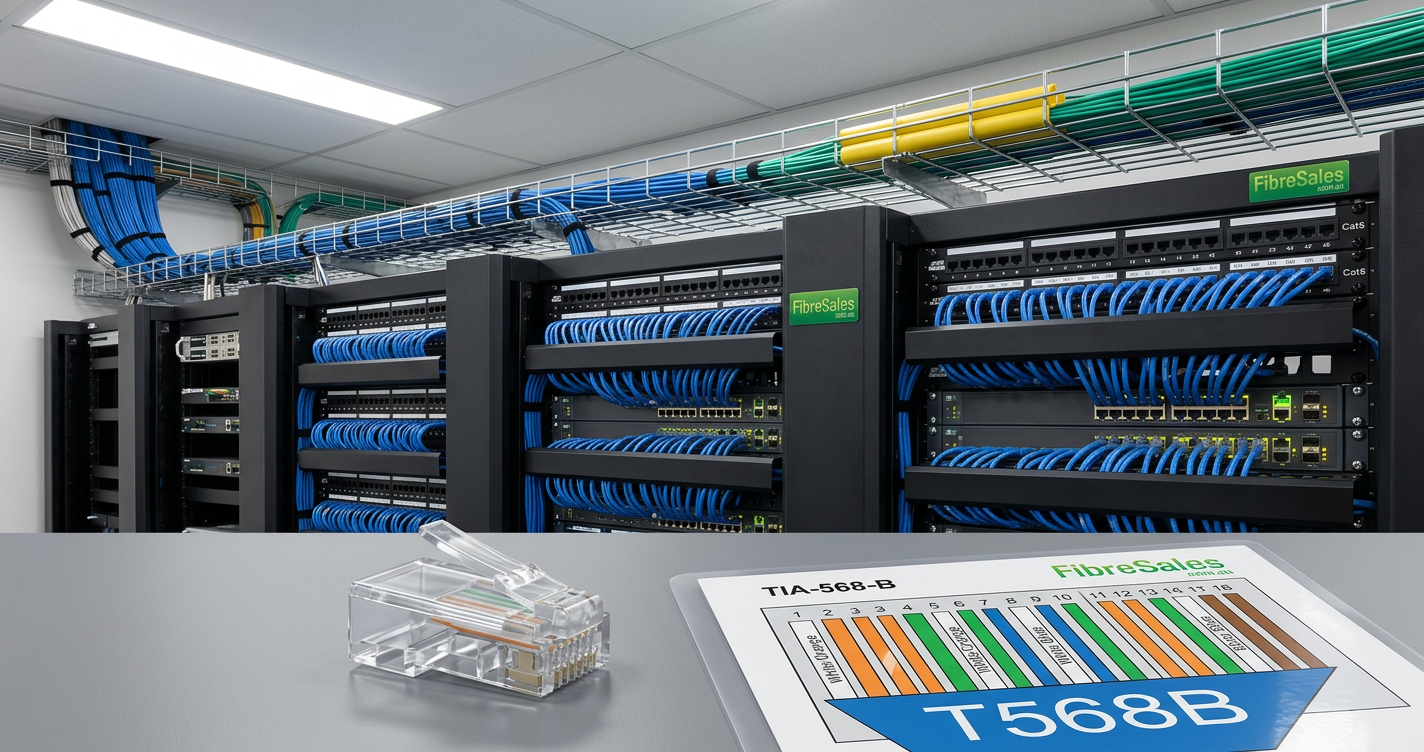
Rather than repeating the complete wiring diagrams here, our RJ45 Pinout: How to Wire Ethernet Cables Step-by-Step explains the T568A and T568B colour sequences, pin assignments and termination process in detail.
Why Australia Commonly Uses T568B
Although Australian cabling standards recognise both wiring schemes, T568B has become the preferred choice for most commercial structured cabling installations.
Several practical factors have contributed to its widespread adoption:
- Most commercial buildings already use T568B.
- Many Australian data cabling contractors routinely install T568B.
- Factory-manufactured Ethernet patch leads commonly follow the T568B wiring arrangement.
- Network expansions are easier when new cabling matches the existing infrastructure.
- Future maintenance becomes simpler when every outlet follows the same wiring standard.
For these reasons, organisations rarely change wiring standards when upgrading an existing network. Matching the established infrastructure reduces installation errors and helps ensure long-term compatibility.
Why Commercial Buildings Standardise on T568B
Commercial networks are designed to remain in service for many years while supporting equipment upgrades, office refurbishments and business growth.
Using a single wiring standard throughout a building delivers several important advantages:
- Simplifies future maintenance.
- Reduces troubleshooting time.
- Supports consistent network documentation.
- Improves compatibility with existing patch panels and outlets.
- Makes future expansions easier.
Large commercial buildings may contain hundreds or even thousands of network outlets. Standardising on one recognised wiring method allows different contractors to work on the same infrastructure without introducing unnecessary inconsistencies.
This approach aligns with industry guidance published by the BICSI Telecommunications Distribution Methods Manual (TDMM), which promotes consistent structured cabling practices throughout the lifecycle of a network.
Engineering Decision
When planning a new Ethernet installation, the question should not be “Which standard is faster?” because both T568A and T568B provide identical network performance.
Instead, ask:
“Which wiring standard already exists within the building?”
In most Australian commercial environments, the answer is T568B.
Maintaining a consistent wiring standard throughout the network simplifies installation, supports future upgrades and helps ensure compatibility with existing infrastructure. Combined with professionally manufactured Cat6 Patch Cables, a consistent T568B installation provides a reliable foundation for modern Ethernet networks.
The Importance of Consistency in Structured Cabling
One of the core principles of structured cabling is consistency. Whether a building contains ten network outlets or ten thousand, every permanent cable should follow the same wiring standard throughout the installation.
Although both T568A and T568B comply with the ANSI/TIA-568 Structured Cabling Standard, mixing standards unnecessarily within the same structured cabling system can create confusion during maintenance, troubleshooting and future expansions.
By standardising on a single wiring method, network administrators and contractors can:
- Simplify cable identification.
- Reduce installation errors.
- Improve maintenance efficiency.
- Support future network upgrades.
- Maintain accurate documentation.
- Reduce troubleshooting time.
For these reasons, consistency is often more important than the choice between T568A and T568B itself.
Compatibility with Existing Network Infrastructure
Modern commercial networks evolve over many years. New offices are added, communications cabinets are expanded and network hardware is upgraded without replacing every Ethernet cable.
Maintaining compatibility with the existing infrastructure makes these upgrades significantly easier.
For example, matching the established wiring standard helps ensure compatibility with:
- Existing wall outlets.
- Patch panels.
- Communications cabinets.
- Network switches.
- Documentation records.
- Installed Ethernet cabling.
If a building already uses T568B throughout its structured cabling system, continuing with T568B eliminates unnecessary inconsistencies and reduces the likelihood of wiring errors during future projects.
Professionally manufactured Cat6 Patch Cables also integrate seamlessly into these environments because they are designed for standard Ethernet networking applications.
How T568B Is Used Around the World
Although both recognised wiring standards remain in use, T568B has become the dominant choice for many commercial Ethernet installations worldwide.
Australia
Australian commercial buildings commonly use T568B because it aligns with existing structured cabling infrastructure and simplifies future maintenance and network expansion. While Australian standards recognise both wiring methods, most contractors continue the standard already installed within the building.
United States
In the United States, both T568A and T568B are recognised under the ANSI/TIA-568 Structured Cabling Standard. However, T568B became widely adopted in commercial environments due to its historical compatibility with earlier AT&T 258A wiring practices, and many organisations continue using it today.
Europe
Across Europe, installation practices vary between countries and organisations. Many commercial projects use T568B for compatibility with existing infrastructure, while others follow project specifications that may nominate either wiring standard.
Government and Specialised Projects
Some government departments, defence organisations and legacy facilities specify T568A to maintain compatibility with their existing cabling infrastructure. In these situations, installers follow the project specification rather than changing to T568B.
The key lesson is that consistency within the installation always takes priority over the specific wiring sequence chosen.
When T568A Makes Sense
Despite the widespread adoption of T568B, T568A remains a recognised and fully compliant wiring standard.
Choosing T568A may be appropriate when:
- An existing building already uses T568A.
- Project specifications require T568A.
- Government or defence contracts nominate T568A.
- Network upgrades must remain compatible with legacy infrastructure.
Changing an established T568A installation simply to adopt T568B rarely provides any practical benefit because both standards deliver identical Ethernet performance.
Instead, installers should extend the existing wiring standard to maintain consistency throughout the network.
why-most-ethernet-networks-use-T568b – Engineering Decision
Experienced network engineers rarely choose a wiring standard based on performance because there is no performance advantage between T568A and T568B.
Instead, they consider the long-term lifecycle of the network.
Matching the existing structured cabling system improves compatibility, simplifies maintenance and makes future upgrades more straightforward. In Australia, that usually means continuing with T568B because it has become the de facto standard across many commercial Ethernet installations.
Where T568A already exists, however, extending the existing standard is almost always the best engineering decision.
Common Misconceptions About T568B
Although T568B has become the preferred wiring standard for many commercial Ethernet installations, several misconceptions continue to circulate within the networking industry. Understanding the facts helps installers make informed decisions and avoid unnecessary rewiring.
“T568B Is Faster Than T568A”
This is one of the most common myths.
There is no performance difference between T568A and T568B. Both wiring standards support the same Ethernet technologies when installed correctly, including:
- Fast Ethernet (100 Mbps)
- Gigabit Ethernet (1 Gbps)
- Multi-Gig Ethernet
- 10 Gigabit Ethernet (with the appropriate cable category)
- Power over Ethernet (PoE)
Network performance depends on factors such as cable category, installation quality, termination accuracy and compliance with recognised standards—not the choice between T568A and T568B.
“You Should Always Convert T568A to T568B”
Not necessarily.
If an existing building has been installed using T568A, there is usually no technical reason to rewire the entire installation simply to change the wiring standard.
Doing so increases cost without improving network performance.
Instead, professional installers generally extend the existing infrastructure using the same wiring standard already in place.
“Every Country Uses T568B”
While T568B is the dominant commercial wiring standard in many regions, both T568A and T568B remain recognised internationally.
The preferred wiring method often depends on:
- Existing building infrastructure.
- Customer specifications.
- Government requirements.
- Legacy network installations.
- Organisational standards.
This is why professional contractors always inspect the existing network before commencing new structured cabling work.
Why Future Expansion Matters
Structured cabling systems are designed to support decades of operation. During that time, organisations commonly:
- Add new offices.
- Install additional wireless access points.
- Upgrade network switches.
- Increase workstation numbers.
- Expand communications cabinets.
- Deploy new IP devices.
Every expansion becomes easier when the original installation follows a consistent wiring standard.
For example, if a building already uses T568B throughout its communications rooms, patch panels and wall outlets, new cabling can integrate without introducing unnecessary complexity.
Combined with professionally manufactured Cat6 Patch Cables, maintaining a consistent structured cabling standard helps ensure reliable network performance for many years.
Real-World Example
A business occupies one floor of an office building and later expands into two additional levels. The original structured cabling system was installed using T568B, with every outlet documented and labelled accordingly.
Rather than introducing a different wiring standard during the expansion, the contractor extends the existing T568B infrastructure. The new communications cabinets, patch panels and network outlets match the original installation, allowing technicians to maintain a consistent wire map across the entire building.
Because the installation follows a single recognised wiring standard, future maintenance, fault finding and equipment upgrades become significantly easier. Network documentation also remains consistent, reducing the risk of wiring errors when additional contractors work on the system years later.
Best Practices for Choosing a Wiring Standard
Whether you’re installing a small office network or a large commercial structured cabling system, the following best practices help ensure long-term reliability:
- Match the existing wiring standard wherever possible.
- Use the same wiring method throughout the entire installation.
- Document the chosen standard for future maintenance.
- Test every terminated cable before commissioning.
- Follow recognised industry standards during installation.
- Use quality networking components designed for the application.
Rather than focusing on whether T568A or T568B is “better”, professional installers focus on delivering a network that is consistent, standards-compliant and easy to maintain.
why-most-ethernet-networks-use-t568b – Engineering Decision
The success of a structured cabling system depends far more on consistency than on the choice between T568A and T568B. Both wiring standards deliver identical Ethernet performance when installed correctly.
For most Australian commercial networks, continuing with T568B provides the greatest compatibility with existing infrastructure, simplifies future expansion and aligns with common industry practice. However, where an existing installation already uses T568A, maintaining that standard is usually the most practical engineering decision.
The best network is not the one that follows a particular colour sequence—it is the one that remains consistent, well documented and professionally installed throughout its entire lifecycle.
Frequently Asked Questions
Why do most commercial networks use T568B?
Most commercial networks use T568B because it has become the established wiring standard across much of the existing Ethernet infrastructure. Continuing to use the same standard simplifies maintenance, supports future network expansions and ensures compatibility with existing structured cabling systems.
Does T568B provide faster network speeds?
No.
T568B and T568A deliver identical electrical performance. Both wiring standards support Gigabit Ethernet, 10 Gigabit Ethernet (with the appropriate cable category) and Power over Ethernet (PoE).
Network performance depends on cable quality, installation practices and correct termination rather than the wiring standard itself.
Why is T568B so common in Australia?
Most Australian commercial buildings have historically been wired using T568B. As organisations renovate or expand their networks, contractors generally continue using the existing wiring standard to maintain consistency throughout the structured cabling system.
This approach reduces installation errors and makes future maintenance significantly easier.
Can I use T568A instead?
Yes.
T568A remains a recognised wiring standard under the ANSI/TIA-568 Structured Cabling Standard.
T568A is often the correct choice when:
- An existing building already uses T568A.
- Government or defence specifications require it.
- Customer project documentation specifies T568A.
- Legacy infrastructure must remain consistent.
The most important consideration is maintaining the same wiring standard throughout the installation.
Should I convert an existing T568A installation to T568B?
Generally, no.
Changing a correctly functioning T568A installation to T568B provides no improvement in Ethernet performance and can introduce unnecessary cost and disruption.
Professional installers normally extend the existing wiring standard rather than replacing it.
How do I know which wiring standard my building uses?
The simplest approach is to inspect an existing network outlet or patch panel.
If the cabling documentation is unavailable, a qualified cabling technician can identify whether the installation follows T568A or T568B before any new work begins.
Matching the existing infrastructure helps maintain consistency across the entire network.
Where can I see the T568B wiring sequence?
This article focuses on why organisations choose T568B rather than how to terminate Ethernet cables.
For wiring diagrams, colour codes and step-by-step termination instructions, read RJ45 Pinout: How to Wire Ethernet Cables Step-by-Step.
Why fibreSales?
At fibreSales, we understand that successful Ethernet installations rely on more than quality products—they also depend on following recognised industry standards and consistent installation practices.
Whether you’re expanding an existing commercial network or installing structured cabling for a new project, fibreSales supplies professionally manufactured Cat6 Patch Cables together with RJ45 Crimping Tools, RJ45 Connectors, Cable Testers, Keystone Jacks, Wire Strippers and Punch-down Tools to help build reliable, standards-compliant Ethernet networks.
Conclusion
T568B has become the preferred wiring standard for many commercial Ethernet networks, not because it delivers better performance than T568A, but because it offers continuity with existing infrastructure. Across Australia and many international markets, organisations continue to use T568B because it simplifies maintenance, supports future expansion and keeps structured cabling systems consistent.
Both T568A and T568B remain fully recognised wiring standards, and both support modern Ethernet technologies when installed correctly. The most important decision is not which colour sequence you choose, but ensuring the entire network follows the same standard from end to end.
For reliable Ethernet installations, combine recognised wiring practices with professionally manufactured Cat6 Patch Cables and quality networking products from www.fibresales.com.au.
Continue Learning
Expand your networking knowledge with these related fibreSales resources:
- RJ45 Pinout: How to Wire Ethernet Cables Step-by-Step
- RJ45 Connectors Explained
- What Does RJ45 Mean?
- Ethernet Cable Testing Guide
- Understanding PoE and Ethernet Cables | Complete Guide
- Copper Networking Explained | The Complete Guide to Ethernet Networks
- Copper Patch Leads Explained | The Complete Guide to Ethernet Patch Cables
- PoE vs PoE+ vs PoE++
- PoE JR45 Pinout
- RJ45 Punch-Down Tool
References
- ANSI/TIA-568 Structured Cabling Standard
- IEEE 802.3 Ethernet Standard
- ISO/IEC 11801 Generic Cabling Standard
- BICSI Telecommunications Distribution Methods Manual (TDMM)
- ACMA Cabling Standards
Related Products
You may also be interested in: