What Does RJ45 Mean?
RJ45 is one of the most recognised terms in computer networking, yet it is also one of the most misunderstood. Most people use “RJ45” to describe the plastic connector fitted to the end of an Ethernet cable. However, the term originally referred to a registered jack wiring standard developed for telephone systems rather than the Ethernet connector itself.
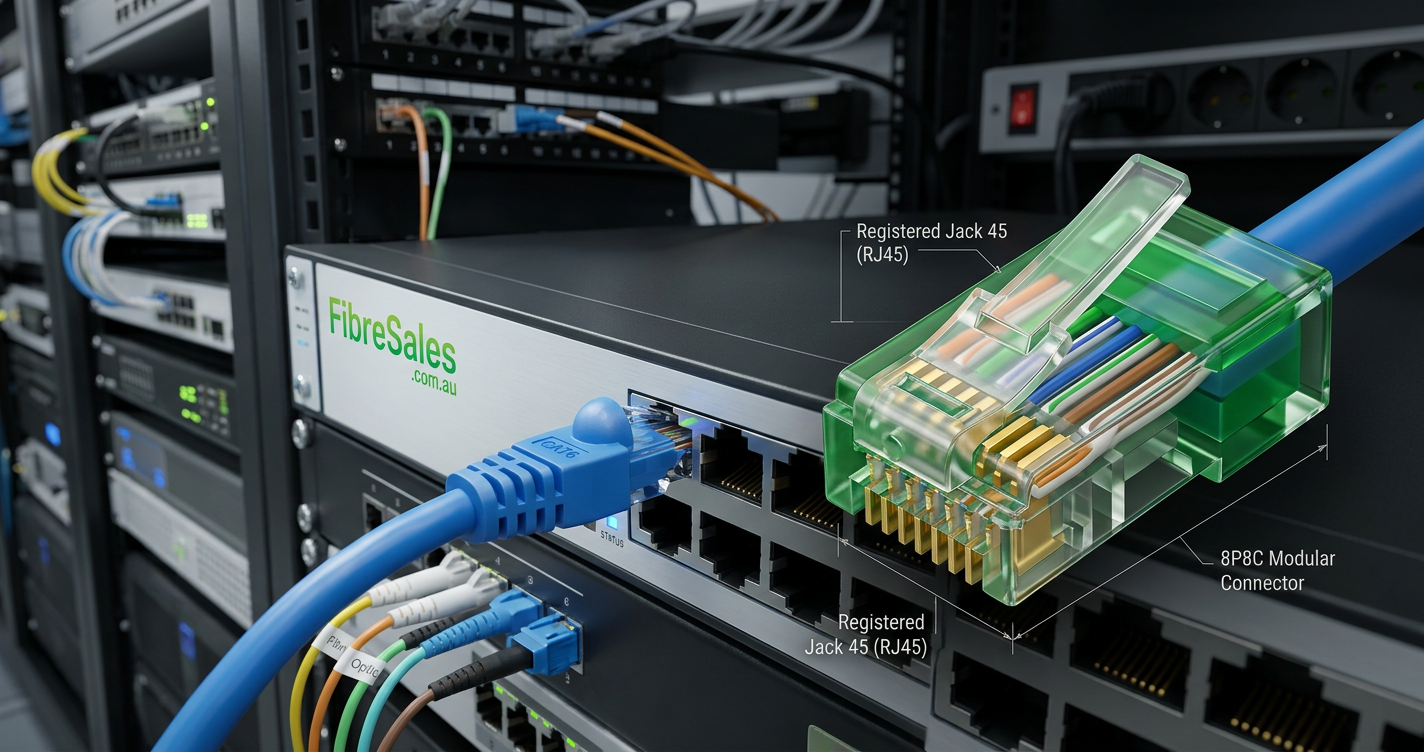
Today, networking professionals, manufacturers and installers commonly use “RJ45” when referring to the modular connector found on Ethernet cables, even though the connector used for modern Ethernet networks is technically an 8P8C (Eight Position, Eight Contact) modular connector.
Understanding what RJ45 really means helps remove confusion when selecting networking products, terminating Ethernet cables and following structured cabling standards.
Whether you’re installing a home network, expanding a business LAN or selecting professionally manufactured Cat6 Patch Cables, understanding the terminology makes it easier to choose the correct products and follow recognised installation practices.
What Does RJ45 Stand For?
RJ45 stands for Registered Jack 45.
The term “Registered Jack” originated through the Bell System in the United States and later became part of the Federal Communications Commission (FCC) registration system for telecommunications connectors. Each registered jack designation defined a specific connector type and wiring arrangement for telephone services.
Originally, Registered Jack 45 described a keyed telephone connector with a specific wiring configuration. It was not created for Ethernet networking.
As computer networks evolved, the networking industry adopted the familiar modular connector for Ethernet applications. Over time, installers, manufacturers and equipment vendors began referring to the Ethernet connector simply as an “RJ45 connector”, even though modern Ethernet cables actually use an 8P8C modular connector rather than the original RJ45 telephone specification.
Today, the term RJ45 remains the accepted industry name despite its historical origins.
RJ45 vs 8P8C: What’s the Difference?
One of the biggest misconceptions in networking is that Registered Jack 45 and 8P8C mean exactly the same thing.
Strictly speaking, they do not.
Registered Jack 45 refers to a historical registered jack specification.
8P8C describes the physical connector itself:
- 8 Positions – The connector contains eight conductor positions.
- 8 Contacts – All eight positions contain electrical contacts.
Modern Ethernet cables use the 8P8C modular connector because it supports the four twisted wire pairs required for Gigabit Ethernet, 10 Gigabit Ethernet and Power over Ethernet (PoE).
Although “8P8C” is technically correct, the networking industry almost universally refers to these connectors as RJ45 connectors, making both terms widely recognised in practice.
Why are Ethernet connectors Still Used Today?
The term Registered Jack 45 has become deeply embedded throughout the networking industry.
You’ll find it used by:
- Network equipment manufacturers.
- Structured cabling suppliers.
- Electrical contractors.
- IT professionals.
- Telecommunications installers.
- Training organisations.
- Technical documentation.
Because virtually everyone understands what an “RJ45 connector” means, the name continues to be used despite its technical inaccuracy.
For this reason, fibreSales also uses the term RJ45 throughout its networking resources while acknowledging that Ethernet networks actually use 8P8C modular connectors.
Where Are Modular Connectors Used?
RJ45 connectors appear in almost every copper Ethernet network.
Common applications include:
- Desktop computers.
- Network switches.
- Routers.
- Wireless access points.
- VoIP telephones.
- Network printers.
- IP security cameras.
- Network-attached storage (NAS).
- Communications cabinets.
- Data centres.
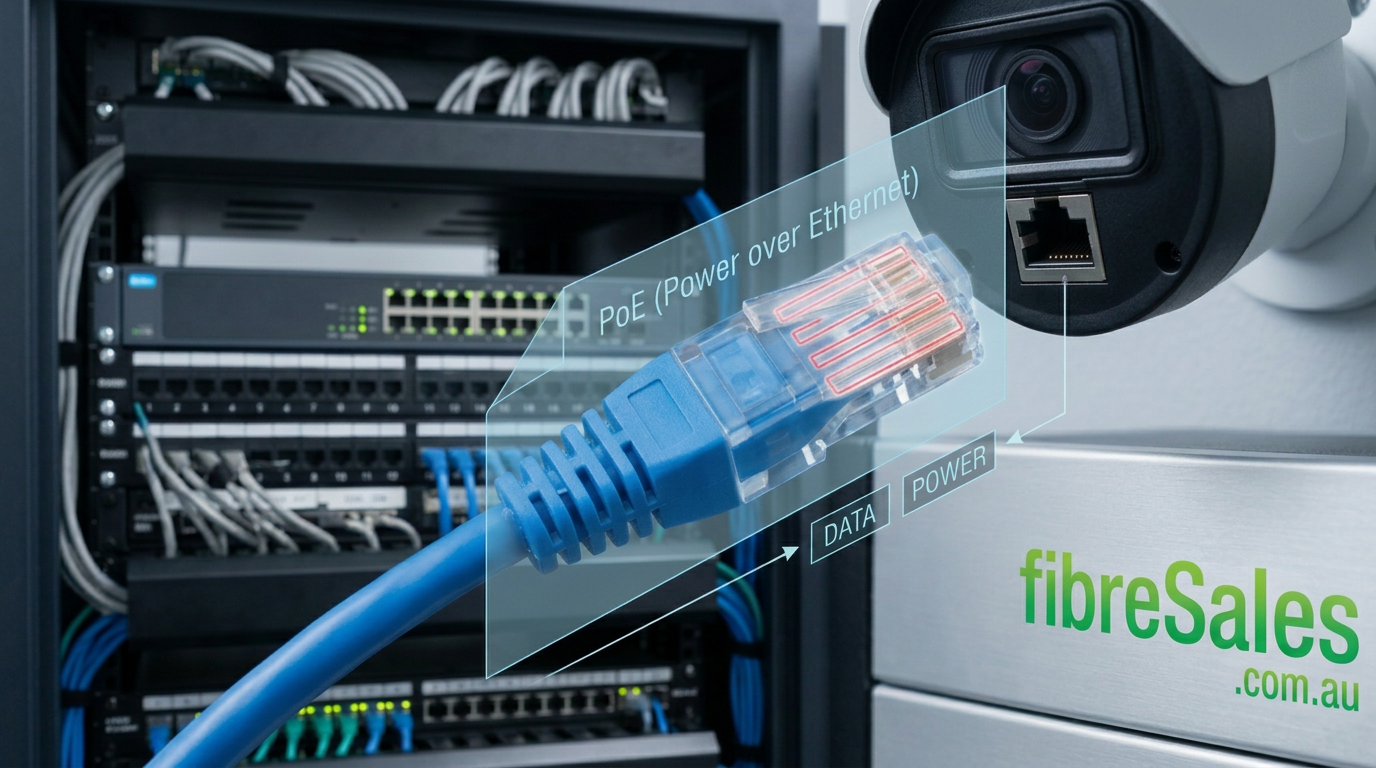
Many of these devices also support Power over Ethernet (PoE), allowing a single Ethernet cable to carry both data and electrical power. If you’re planning a PoE installation, our Understanding PoE and Ethernet Cables | Complete Guide explains cable selection, power standards and deployment best practices.
Does Registered Jack45 Mean the Same as Ethernet?
Not exactly.
Registered Jack 45 refers to the connector terminology, while Ethernet describes the networking technology that communicates across the cable.
In simple terms:
- RJ45 refers to the connector.
- Ethernet refers to the communication standard.
- Cat5e, Cat6 and Cat6A describe the cable categories.
These technologies work together to create modern Local Area Networks (LANs).
If you’d like to understand how Ethernet networks operate, read Copper Networking Explained | The Complete Guide to Ethernet Networks, which covers Ethernet fundamentals, network architecture and structured cabling concepts in detail.
Engineering Decision
Understanding what RJ45 means helps you choose networking products with greater confidence. Although the term technically originated as a telephone connector specification, it has become the accepted name for the modular connector used on Ethernet networks worldwide.
When purchasing networking products, focus less on the historical terminology and more on selecting components that match your installation. Professionally manufactured Cat6 Patch Cables provide factory-tested reliability for equipment connections, while custom Ethernet cables require compatible RJ45 connectors, quality installation tools and correct termination practices.
How Did RJ45 Become the Standard for Ethernet?
Although RJ45 originated as a registered jack specification for telephone systems, the networking industry adopted the same modular connector format as Ethernet technology evolved. As Local Area Networks (LANs) became the standard for connecting computers, printers, servers and network equipment, the familiar eight-position modular connector proved reliable, cost-effective and easy to manufacture.
Every copper Ethernet network uses what is commonly referred to as an RJ45 connector, regardless of whether the network operates at 10 Mbps, 100 Mbps, 1 Gigabit or 10 Gigabit Ethernet.
This widespread adoption has made “RJ45” the universally recognised name throughout the networking industry, even though the connector itself is technically an 8P8C modular connector.
Professional Ethernet installations should follow recognised standards such as the IEEE 802.3 Ethernet Standard and the ANSI/TIA-568 Structured Cabling Standard to ensure compatibility between network devices and cabling infrastructure.
Why Is RJ45 Important?
RJ45 connectors form the physical connection between Ethernet cables and networking equipment. Without them, devices cannot communicate across a wired network.
You’ll find RJ45 connectors on:
- Desktop and workstation computers.
- Network switches.
- Routers and firewalls.
- Wireless access points.
- Network printers.
- VoIP telephones.
- IP security cameras.
- Network Attached Storage (NAS).
- Smart televisions.
- Industrial networking equipment.
Whether you’re installing a small home office or a large enterprise network, every Ethernet connection relies on properly terminated RJ45 connectors or professionally manufactured patch leads.
For equipment connections where standard cable lengths are suitable, factory-tested Cat6 Patch Cables provide reliable performance while eliminating the need for field termination.
What Does an RJ45 Connector Look Like?
An RJ45 connector is a clear modular plastic plug with eight metal contacts across the front.
Typical features include:
- Eight electrical contacts.
- Plastic locking tab.
- Cable strain relief.
- Conductor channels.
- Cable entry designed for twisted-pair Ethernet cable.
Once installed, the locking tab secures the connector inside the network port, preventing accidental disconnection during normal operation.
Although most people refer to this as an RJ45 connector, it is technically an 8P8C modular connector used for Ethernet communications.
What Devices Use Registered Jack 45 Connectors?
RJ45 connectors appear anywhere wired Ethernet networking is required.
Common examples include:
| Device | Uses an RJ45 Connector? |
|---|---|
| Desktop computer | ✔ Yes |
| Laptop docking station | ✔ Yes |
| Network switch | ✔ Yes |
| Router | ✔ Yes |
| Wireless access point | ✔ Yes |
| VoIP phone | ✔ Yes |
| IP security camera | ✔ Yes |
| Network printer | ✔ Yes |
| Smart TV | ✔ Yes |
| Patch panel (via Keystone Jack) | ✘ No |
Permanent structured cabling is normally terminated into Keystone Jacks rather than directly into RJ45 connectors. Equipment is then connected to the network using professionally manufactured Cat6 Patch Cables.
RJ45 and Ethernet Cable Categories
One of the most common misconceptions is that RJ45 refers to a specific Ethernet cable.
It does not.
RJ45 describes the connector terminology, while Cat5e, Cat6 and Cat6A identify the cable category and performance characteristics.
For example:
| Term | Meaning |
|---|---|
| RJ45 | Common name for the Ethernet connector |
| 8P8C | Technical name for the connector |
| Cat5e | Ethernet cable category supporting Gigabit Ethernet |
| Cat6 | Higher-performance Ethernet cable supporting 10 Gigabit Ethernet over shorter distances |
| Cat6A | Enhanced Category 6 cable supporting 10 Gigabit Ethernet over longer distances |
If you’d like to understand how these cable categories differ, our Copper Networking Explained | The Complete Guide to Ethernet Networks and Can Cat6 Run 10G? provide detailed guidance.
Engineering Decision
Understanding what Registered Jack 45 means helps remove one of the most common sources of confusion in networking. While the term originated from a telephone wiring specification, today’s networking industry uses it almost universally when referring to the modular connector fitted to Ethernet cables.
When selecting networking products, focus on choosing quality components that match your installation requirements. For most switch, router and workstation connections, professionally manufactured Cat6 Patch Cables provide the simplest and most reliable solution. Where custom cable assemblies are required, combine compatible RJ45 connectors with professional installation tools and follow recognised structured cabling standards to achieve consistent, long-term network performance.
RJ45 vs RJ11: What’s the Difference?
One of the most common networking questions is whether RJ45 and RJ11 connectors are the same. Although they look similar, they serve completely different purposes and are not interchangeable.
Designed primarily for telephone and voice communication systems, while RJ45 connectors are used for Ethernet data networking.
The most noticeable differences include:
| Feature | RJ45 | RJ11 |
|---|---|---|
| Primary Use | Ethernet networking | Telephone systems |
| Contacts | 8P8C (8 positions, 8 contacts) | Typically 6P2C or 6P4C |
| Cable Type | Cat5e, Cat6, Cat6A Ethernet cable | Telephone cable |
| Typical Devices | Computers, switches, routers, access points | Telephones, fax machines, DSL equipment |
| Supports Ethernet | ✔ Yes | ✘ No |
Although an RJ11 plug may physically fit into some RJ45 sockets, doing so is not recommended because it can damage the contacts and prevent reliable Ethernet communication.
Is RJ45 Used for Power over Ethernet (PoE)?
Yes.
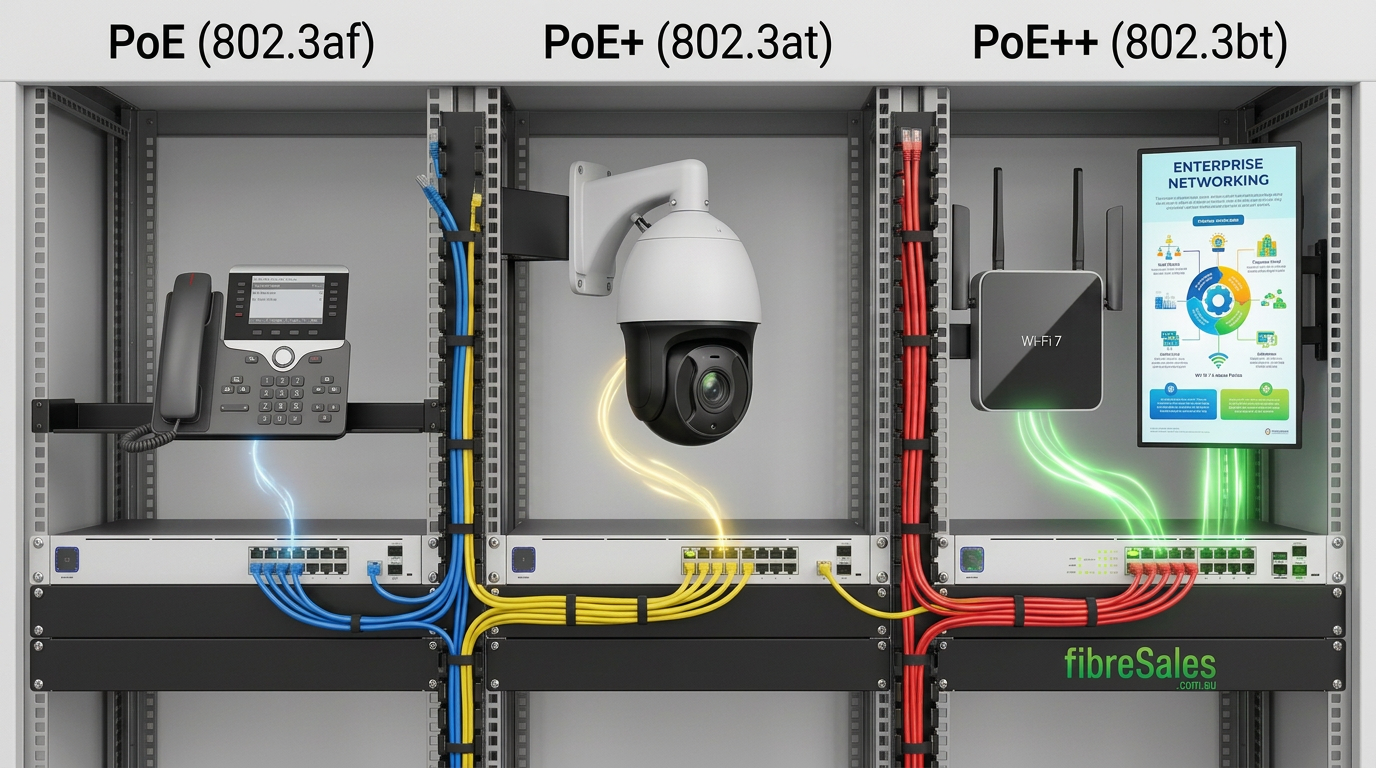
RJ45 connectors are the standard interface used by Power over Ethernet (PoE) technology, allowing a single Ethernet cable to carry both network data and electrical power.
PoE simplifies installations by removing the need for separate power supplies for compatible devices such as:
- Wireless access points.
- IP security cameras.
- VoIP telephones.
- Building automation controllers.
- Network sensors.
When planning a PoE installation, selecting suitable Ethernet cabling is just as important as selecting the correct connector. Our Understanding PoE and Ethernet Cables | Complete Guide explains PoE standards, cable selection and deployment best practices.
How Does an Registered Jack 45 Connector Work?
An Registered Jack 45 connector provides eight electrical contacts that align with matching contacts inside an Ethernet socket.
When the connector is inserted:
- The locking tab secures the connector.
- Each contact mates with the corresponding contact inside the network port.
- Electrical signals pass through the eight conductors inside the Ethernet cable.
- Devices exchange data using Ethernet protocols defined by the IEEE 802.3 Ethernet Standard.
Correct conductor placement is essential for reliable communication. If you’re terminating Ethernet cables yourself, follow the wiring sequences described in RJ45 Pinout: How to Wire Ethernet Cables Step-by-Step.
Common Misconceptions About RJ45
Several misconceptions still exist.
“RJ45 is the technical name for the connector.”
Not quite.
The connector used on modern Ethernet cables is technically an 8P8C modular connector. However, the networking industry universally refers to it as an RJ45 connector, making both terms widely recognised.
“RJ45 is an Ethernet cable.”
No.
RJ45 describes the connector, not the cable.
Ethernet cables are classified by performance categories such as Cat5e, Cat6 and Cat6A.
Professionally manufactured Cat6 Patch Cables combine Cat6 Ethernet cable with factory-terminated RJ45 connectors to deliver reliable network performance.
“Every Ethernet connector is the same.”
No.
Ethernet connectors vary depending on:
- Cable category.
- Conductor size.
- Installation method.
- Connector design.
Choosing compatible components makes installation easier and helps achieve long-term reliability.
For more information, see RJ45 Connectors Explained.
Real-World Example
A business is upgrading its office network to support faster data speeds and additional wireless access points.
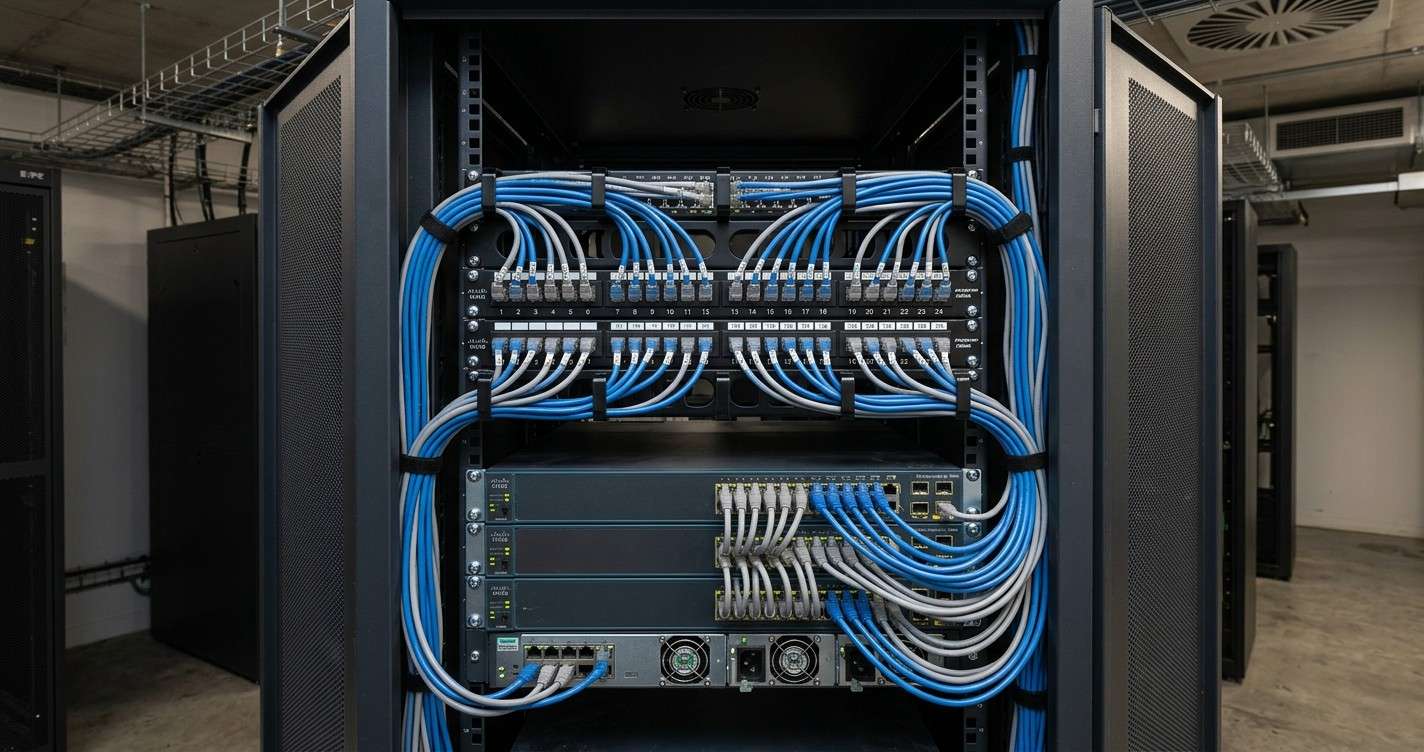
The IT installer specifies permanent Cat6 horizontal cabling terminated into Keystone Jacks throughout the building. Network switches are connected to the patch panel using factory-tested Cat6 Patch Cables with Ethernet connectors.
Although everyone involved refers to the connectors as RJ45, the installer understands they are technically 8P8C modular connectors operating in accordance with recognised structured cabling standards, including the ANSI/TIA-568 Structured Cabling Standard and the BICSI Telecommunications Distribution Methods Manual (TDMM).
Using the correct terminology helps explain the technology, while selecting quality products ensures the finished network performs reliably.
Engineering Decision
Understanding the difference between RJ45, RJ11 and 8P8C helps you make informed networking decisions and avoid common installation mistakes. While the terminology can be confusing, the practical decision is straightforward: use quality Ethernet components designed for your network.
For equipment connections, professionally manufactured Cat6 Patch Cables provide factory-tested reliability. Where custom cable assemblies are required, combine compatible RJ45 connectors with professional installation tools and verify every completed cable before deployment to achieve consistent, standards-compliant performance.
Common Myths About RJ45
Because the term RJ45 has been used for decades, several myths continue to cause confusion for home users, IT professionals and installers. Understanding the facts helps you choose the right networking products and avoid common mistakes.
Myth 1: RJ45 Is an Ethernet Cable
This is one of the most common misconceptions.
RJ45 does not refer to the cable itself. It is the commonly used name for the modular connector fitted to the end of an Ethernet cable.
The cable is classified separately using performance categories such as Cat5e, Cat6 or Cat6A.
For most residential and commercial network installations, professionally manufactured Cat6 Patch Cables combine quality Ethernet cable with factory-terminated connectors, providing reliable performance without requiring field termination.
Myth 2: Every Ethernet Connector Is the Same
Although Ethernet connectors appear similar, they are manufactured to suit different cable categories and conductor sizes.
Using a connector that does not match the cable being terminated can make installation more difficult and may reduce long-term reliability.
If you’re selecting connectors for custom cable assemblies, our RJ45 Connectors Explained guide explains connector compatibility, installation methods and the factors to consider before purchasing.
Myth 3: RJ45 and 8P8C Are Different Connectors
Not exactly.
Modern Ethernet equipment uses an 8P8C modular connector, while “RJ45” is the name most people use to describe it.
From a networking perspective, installers, manufacturers and suppliers generally understand RJ45 to mean the standard Ethernet connector used with twisted-pair cabling.
Knowing the historical difference improves technical accuracy, but both terms are widely recognised throughout the industry.
Myth 4: You Can Wire Any RJ Connector the Same Way
Correct wiring depends on the Ethernet standard being used.
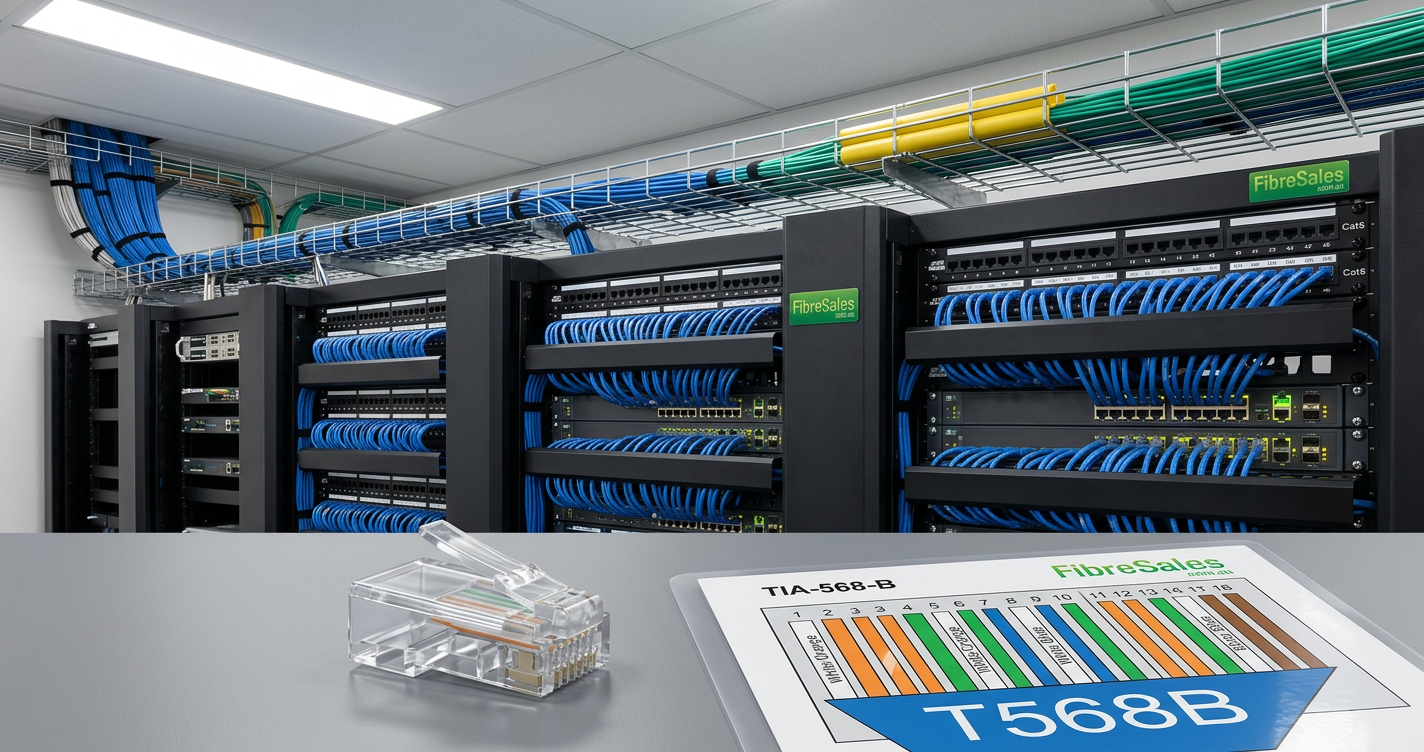
Modern Ethernet installations follow either the T568A or T568B wiring arrangement, with both ends of the cable terminated consistently.
Rather than repeating those instructions here, see RJ45 Pinout: How to Wire Ethernet Cables Step-by-Step for the complete wiring guide, colour codes and termination diagrams.
Best Practices When Working with Ethernet Connectors
Whether you’re installing a single workstation or building an entire structured cabling system, following recognised best practices improves reliability and reduces future maintenance.
Professional installers typically:
- Select connectors that match the cable category.
- Use quality installation tools.
- Test every completed Ethernet cable.
- Minimise cable strain near connectors.
- Follow recognised structured cabling standards.
- Use factory-terminated patch leads where practical.
Industry guidance such as the ANSI/TIA-568 Structured Cabling Standard and the BICSI Telecommunications Distribution Methods Manual (TDMM) recommends consistent installation practices to achieve reliable network performance.
Real-World Example
A facilities manager is upgrading a small office network and notices that every supplier describes the network connectors as “RJ45”. After researching the terminology, they discover that the connector is technically an 8P8C modular connector, while RJ45 refers to an older registered jack specification.
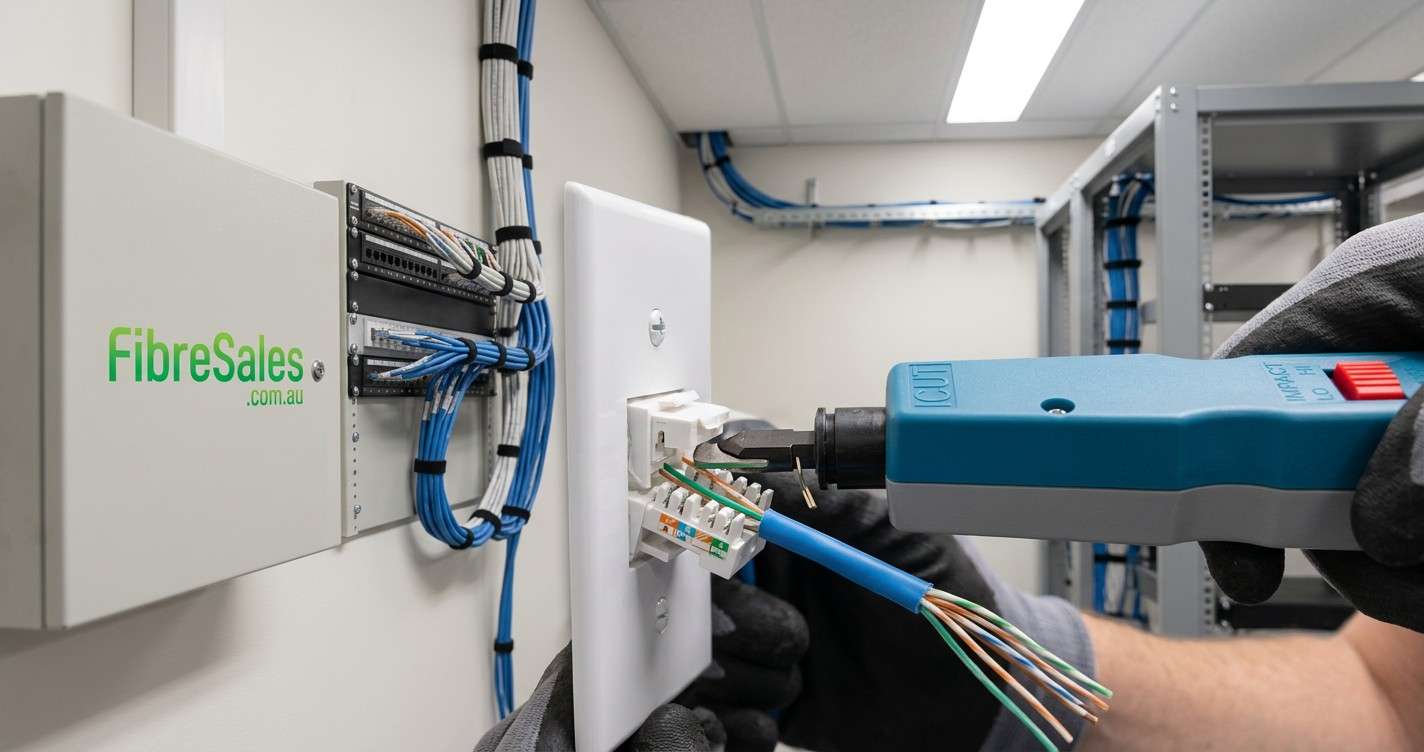
Although the technical terminology differs, selecting compatible products remains straightforward. The installer specifies Cat6 Patch Cables for switch-to-workstation connections and terminates the permanent building cabling into Keystone Jacks using professional Punch-down Tools.
By following recognised installation practices and using quality components, the completed network delivers reliable performance while remaining easy to maintain and expand.
Engineering Decision
Understanding the history behind the term RJ45 helps explain why networking documentation sometimes refers to both RJ45 and 8P8C. In practice, both terms describe the connector used on modern Ethernet networks, even though their origins differ.
For most network installations, the important decision is selecting quality components that suit the application. Professionally manufactured Cat6 Patch Cables provide factory-tested reliability for equipment connections, while custom cable assemblies benefit from compatible connectors, professional installation tools and adherence to recognised structured cabling standards.
Frequently Asked Questions
What does RJ45 actually mean?
RJ45 stands for Registered Jack 45. The term originally referred to a registered telephone connector specification developed for telecommunications systems. Today, the networking industry commonly uses RJ45 to describe the modular connector fitted to Ethernet cables, even though the connector itself is technically an 8P8C (Eight Position, Eight Contact) connector.
Is RJ45 the same as an Ethernet connector?
In everyday networking terminology, yes.
Most manufacturers, installers and IT professionals use “RJ45 connector” when referring to the connector found on Ethernet cables. Technically, however, Ethernet networks use an 8P8C modular connector rather than the original RJ45 telephone specification.
Why is it called RJ45 if it isn’t technically correct?
The name became widely accepted as Ethernet networking grew in popularity. Although the original RJ45 specification related to telephone wiring, the industry adopted the term because the connectors looked similar and served a comparable purpose as modular cable terminations.
Today, “RJ45” is the universally recognised name used throughout the networking industry.
What is the difference between RJ45 and 8P8C?
RJ45 originally referred to a registered jack wiring specification.
8P8C describes the physical connector used on modern Ethernet cables.
In practice, both terms often refer to the same connector, although 8P8C is the technically correct description.
Does every Ethernet cable use an RJ45 connector?
Most copper Ethernet patch cables use RJ45 (8P8C) connectors.
For example, professionally manufactured Cat6 Patch Cables are supplied with factory-terminated RJ45 connectors ready for immediate installation.
Some specialised networking systems, such as fibre optic networks, use completely different connector types.
Is RJ45 used for Cat5e, Cat6 and Cat6A?
Yes.
RJ45 connectors are commonly used across Cat5e, Cat6 and Cat6A Ethernet cabling.
The cable category determines the network performance, while the connector provides the physical interface between the cable and network equipment.
Can I use an RJ45 connector for telephone wiring?
Although RJ45 originated from telephone connector standards, modern telephone systems typically use RJ11 connectors rather than RJ45 connectors.
RJ11 connectors are smaller and designed specifically for voice applications, while RJ45 connectors support Ethernet networking.
Where can I learn how to wire an RJ45 connector?
If you’re building custom Ethernet cables, our RJ45 Pinout: How to Wire Ethernet Cables Step-by-Step explains T568A and T568B wiring standards, colour codes and correct termination practices.
If you’re choosing connectors for a new installation, RJ45 Connectors Explained provides detailed guidance on connector compatibility and selection.
Why fibreSales?
Whether you’re learning about Ethernet networking or purchasing products for your next installation, fibreSales provides practical technical resources backed by quality networking products.
Our range includes professionally manufactured Cat6 Patch Cables together with installation products including Crimping Tools, Wire Strippers, Keystone Jacks, Punch-down Tools and Cable Testers to help you build reliable Ethernet networks with confidence.
Conclusion
Although RJ45 originally described a registered telephone jack specification, the term has become the accepted industry name for the connector used on modern Ethernet networks. Understanding the history behind the name helps explain why networking professionals often use both RJ45 and 8P8C when discussing Ethernet connectors.
More importantly, understanding the terminology helps you make informed purchasing decisions, choose compatible networking products and follow recognised installation practices.
For equipment connections where standard cable lengths are suitable, professionally manufactured Cat6 Patch Cables provide factory-tested reliability and consistent network performance.
For more fibre optic solutions, technical resources and installation products, visit www.fibresales.com.au.
Continue Learning
Expand your networking knowledge with these related fibreSales resources:
- RJ45 Pinout: How to Wire Ethernet Cables Step-by-Step
- RJ45 Connectors Explained
- Understanding PoE and Ethernet Cables | Complete Guide
- Copper Networking Explained | The Complete Guide to Ethernet Networks
- Copper Patch Leads Explained | The Complete Guide to Ethernet Patch Cables
- Can Cat6 Run 10G?
- UTP vs Shielded Cat6 Patch Cables | Which Should You Choose?
- LSZH vs PVC Cat6 Patch Cables | Which Jacket Should You Choose?
- Ethernet Cable Testing Guide
- Why Most Ethernet Networks Use T568B
References
- ANSI/TIA-568 Structured Cabling Standard
- IEEE 802.3 Ethernet Standard
- IEEE 802.3 Power over Ethernet Standard
- ISO/IEC 11801 Generic Cabling Standard
- BICSI Telecommunications Distribution Methods Manual (TDMM)
- ACMA Cabling Standards
Related Products
You may also be interested in: