Fibre Certification vs Qualification
What is the difference?
When commissioning a fibre optic network, many installers use the terms qualification testing and certification testing interchangeably. Although both involve testing fibre optic infrastructure, they serve different purposes and use different procedures.
Understanding the difference between fibre certification and qualification testing helps ensure the correct testing method is selected for each project, avoids unnecessary costs and provides confidence that the network will perform as designed.
If you’re new to fibre optic testing, start with our Fibre Optic Testing Performance Guide, which explains the complete fibre testing process before exploring specific testing methodologies.
Professional testing begins with reliable equipment. FibreSales supplies a comprehensive range of OTDRs, Power Meters, Light Sources , Cleaning Products and Inspection Microscopes, to support professional fibre installation and certification.
What Is Fibre Qualification Testing?
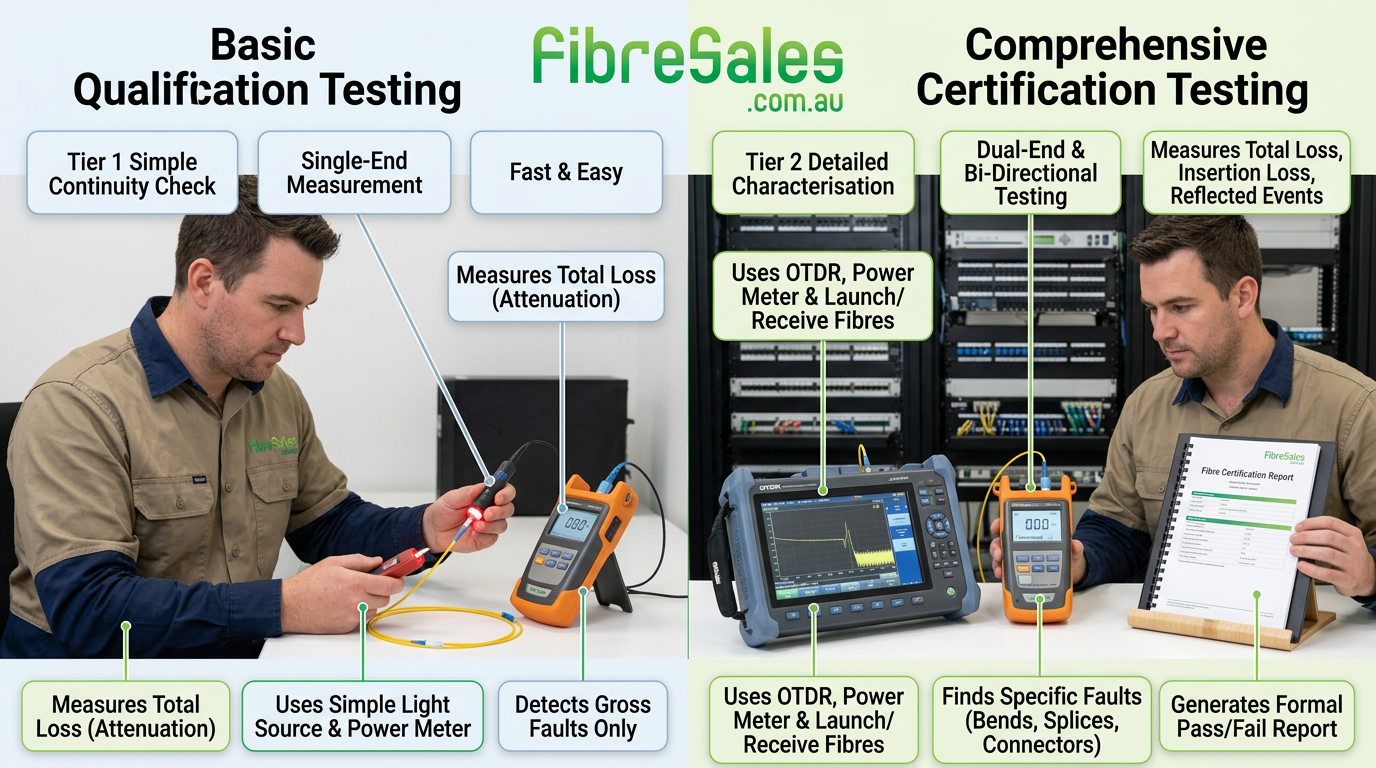
Fibre qualification testing determines whether an installed fibre link is capable of supporting the intended network application.
Rather than proving compliance with a specific cabling standard, qualification testing confirms that the fibre can successfully carry the required Ethernet, Fibre Channel or telecommunications service.
Typical qualification tests include:
- Link continuity
- Fibre length
- Optical loss
- Basic network performance
- Signal integrity
Qualification testing is commonly used after network upgrades, equipment replacements or troubleshooting to determine whether the existing cabling infrastructure is suitable for higher-speed applications.
If insertion loss measurements appear unusually high during qualification testing, our Optical Power Meter Guide explains how to accurately measure end-to-end optical loss.
What Is Fibre Certification Testing?
Fibre certification testing verifies that an installed fibre optic network complies with recognised industry standards, project specifications and manufacturer requirements.
Certification testing produces documented evidence that the installation has been completed correctly and is suitable for handover to the customer.
A certification test typically includes:
- Insertion loss measurements
- Fibre length
- Test wavelength verification
- OTDR analysis (where specified)
- Connector inspection
- Pass/fail results
- Comprehensive test reports
Certification testing is often required for:
- New commercial buildings
- Data centres
- Government projects
- Mining sites
- Hospital infrastructure
- Telecommunications networks
- Warranty validation
Our Fibre Test Report Explained guide explains how to interpret certification reports and understand pass/fail criteria.
Fibre Certification vs Qualification Testing: Key Differences
| Feature | Qualification Testing | Certification Testing |
|---|---|---|
| Purpose | Verify network functionality | Verify compliance with specifications |
| Primary Goal | Confirm application support | Certify installation quality |
| Typical Equipment | Power Meter, Light Source | Power Meter, Light Source, OTDR |
| Documentation | Basic test results | Comprehensive certification reports |
| Standards Compliance | Not always required | Required |
| Common Use | Existing networks | New installations |
| Customer Handover | Rarely | Yes |
Although both testing methods evaluate fibre performance, certification testing provides a significantly higher level of documentation and traceability.
fibre certification vs qualification – When Should Fibre Qualification Testing Be Used?
Fibre qualification testing is suitable when:
- Upgrading network speeds
- Reusing existing cabling
- Troubleshooting intermittent faults
- Confirming fibre continuity
- Assessing older installations
Qualification testing helps determine whether the existing infrastructure can support the required application before investing in replacement cabling.
Engineering Decision
If the objective is to determine whether an existing fibre can support a new network application, qualification testing is usually sufficient. If contractual compliance or warranty documentation is required, certification testing is the appropriate choice.
When Should Fibre Certification Testing Be Used?
Fibre certification testing should be performed whenever formal documentation is required.
Examples include:
- New fibre installations
- Government infrastructure projects
- Commercial construction
- Manufacturer warranty programs
- Customer acceptance testing
- Standards compliance
Certification reports provide an auditable record of the installation and establish a performance baseline for future maintenance.
Equipment Required for Fibre Certification vs Qualification Testing
The equipment required depends on the testing objective.
Qualification Testing Equipment
Typical equipment includes:
Certification Testing Equipment
Professional certification generally includes:
Common Mistakes When Comparing Fibre Certification vs Qualification Testing
Many misunderstandings arise because the two testing methods overlap.
Common mistakes include:
- Assuming qualification testing replaces certification testing.
- Providing qualification results when certification reports are required.
- Omitting connector inspection.
- Failing to document calibration information.
- Relying solely on OTDR testing without insertion loss measurements.
- Ignoring project specifications.
Our
- OTDR Event Table Explained guide explains why OTDR testing should complement, rather than replace, insertion loss testing.
Common Mistake
Passing a qualification test does not automatically mean the installation complies with contractual specifications or industry standards.
fibre certification vs qualification Real-World Field Scenario
A customer planned to upgrade an office backbone from 1 Gb/s to 10 Gb/s using the existing multimode cabling.
Initial qualification testing confirmed acceptable insertion loss using a Power Meter and Light Source, indicating the fibre could support the proposed application. However, because the upgrade formed part of a new commercial fit-out, the client also required certification testing to satisfy project documentation requirements.
Additional OTDR testing identified one connector with elevated reflectance. After cleaning the connector with professional Cleaning Products and confirming the results with an Inspection Microscope, the contractor completed certification testing and issued a comprehensive fibre test report for client handover.
This approach ensured both operational performance and contractual compliance.
Best Practices for Fibre Certification vs Qualification Testing
To achieve reliable results:
- Inspect every connector before testing.
- Clean all connectors before making measurements.
- Use calibrated test equipment.
- Select the correct test wavelengths.
- Follow recognised testing procedures.
- Record all test results.
- Archive certification reports for future maintenance.
Maintaining consistent testing practices improves network reliability and simplifies future fault diagnosis.
Engineering Decision Insight
Understanding the difference between fibre certification vs qualification testing allows technicians to choose the appropriate testing methodology for every project.
Qualification testing confirms that a fibre link can support the intended application, while certification testing verifies compliance with project specifications and recognised industry standards. Both have an important role in professional fibre optic installation, but they are not interchangeable.
Selecting the correct testing approach, using calibrated equipment and maintaining comprehensive documentation ensures reliable network performance and provides confidence for both installers and customers.
References
For further guidance, consult:
- The Fibre Optic Association (FOA) – Fibre optic testing best practices.
- IEC 61280 series – Fibre optic communication subsystem test procedures.
- TIA-568 – Optical fibre cabling standards.
fibre certification vs qualification Conclusion
Choosing between fibre qualification testing and fibre certification testing depends on the project’s objectives. Qualification testing verifies that the network can support the intended application, while certification testing provides documented proof that the installation complies with project specifications and recognised industry standards.
By using the correct testing methodology and professional equipment, installers can minimise troubleshooting, satisfy customer requirements and deliver reliable fibre optic infrastructure with confidence.
For professional OTDRs , Power Meters, Light Sources, Cleaning Products and Inspection Microscopes, visit www.fibresales.com.au to explore Australia’s growing resource centre for fibre optic products, technical guides and professional testing solutions.